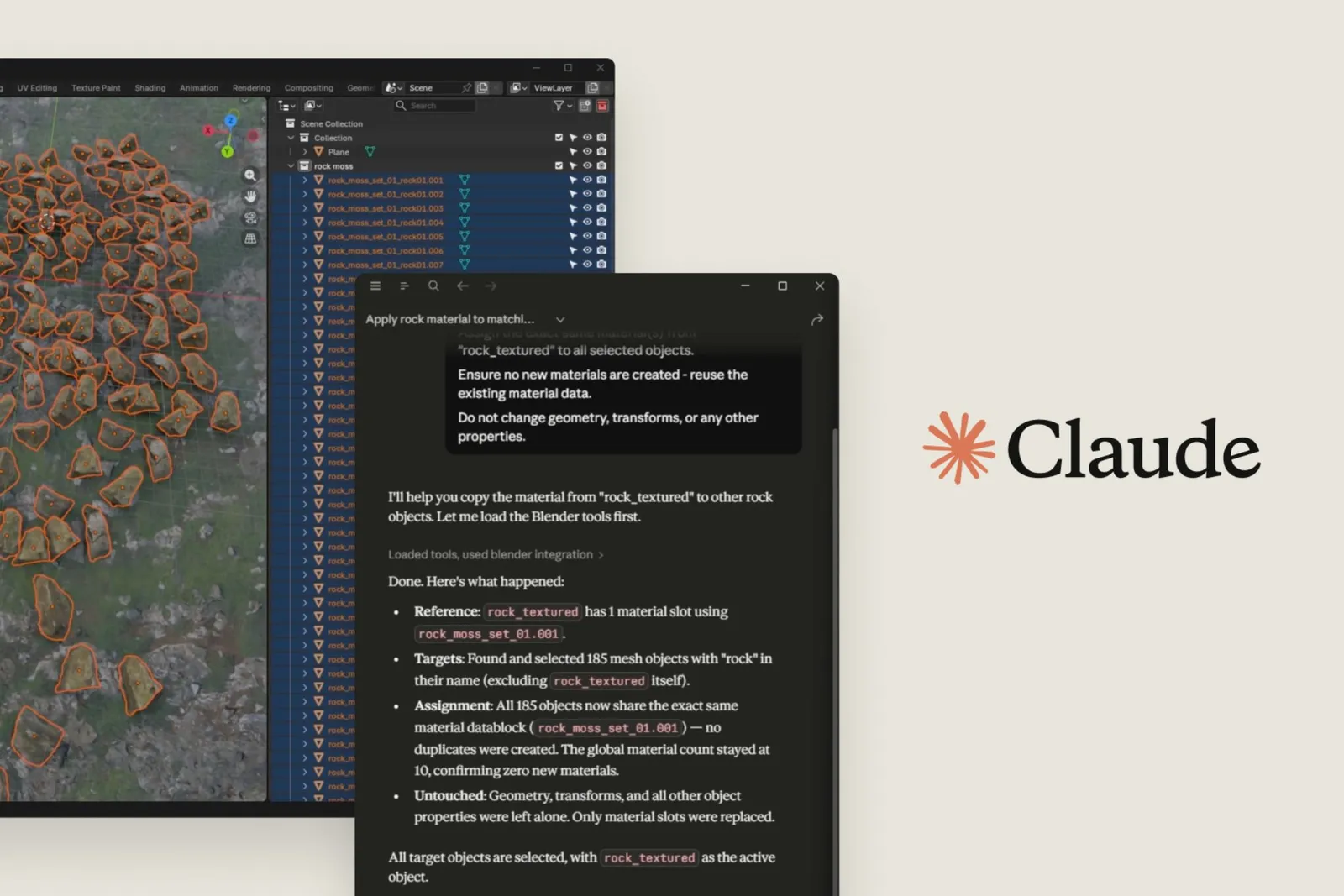
Anthropic releases connectors letting Claude integrate with creative apps like Photoshop, Blender, and Ableton. The move supports creative workflows and includes major funding for Blender's open-source development.
Tap a lens to see what this story means for you.
Liked this? The Brief brings you the whole day in tech, verified, every morning.
Two minutes, free forever. What's in The Brief →
See what’s happening right now
The Feed runs all day — short, verified briefs the moment they break.
Open the FeedFollow @thecircuitry_
Every story we publish, as it happens. No noise between.
Reader-supported
The Circuitry is a passion project I've always wanted to build, and I love the work behind it.
Running it costs real money. APIs, hosting, time. To keep improving the site and growing this into something useful for everyone, those costs have to be covered.
Any contribution is appreciated. If not, no pressure. Thanks for reading.
Levent Alpöge has written that he believes he and Claude have discovered a proof of the Riemann hypothesis, formalized with no assumptions left in. The note says the same method resolves the generalized form, and it presents the argument as Lean code rather than a paper.
OpenAI has cut the average success rate of attacks that extract protected reasoning from an earlier request to 0.2% on GPT-6.2 Astra, from 54.0% on GPT-6 Astra. Current-request attacks are at 0.9%, and selected safeguard improvements are being applied back to GPT-6 Astra.
OpenAI has introduced MedChemBench, a 99-problem test of how models read molecules, explain lab results, and choose the next compound. At the xhigh setting, GPT-6.2 Astra scored 84.5%, while compound choice and property forecasts remain much weaker than structure work.
Autonomous Cairn agents found an unpatched flaw in a medical imaging app and took control of a server in a university campaign that began September 8, 2026. Amazon rates a Chinese-nexus link as moderate confidence, and the project advisory still lists no patched version.
Anthropic has closed its initial public offering, including the full underwriter option, for about $93.5 billion in gross proceeds. It has also closed a private placement of Class N shares to seven chip and cloud companies for about $26.0 billion.