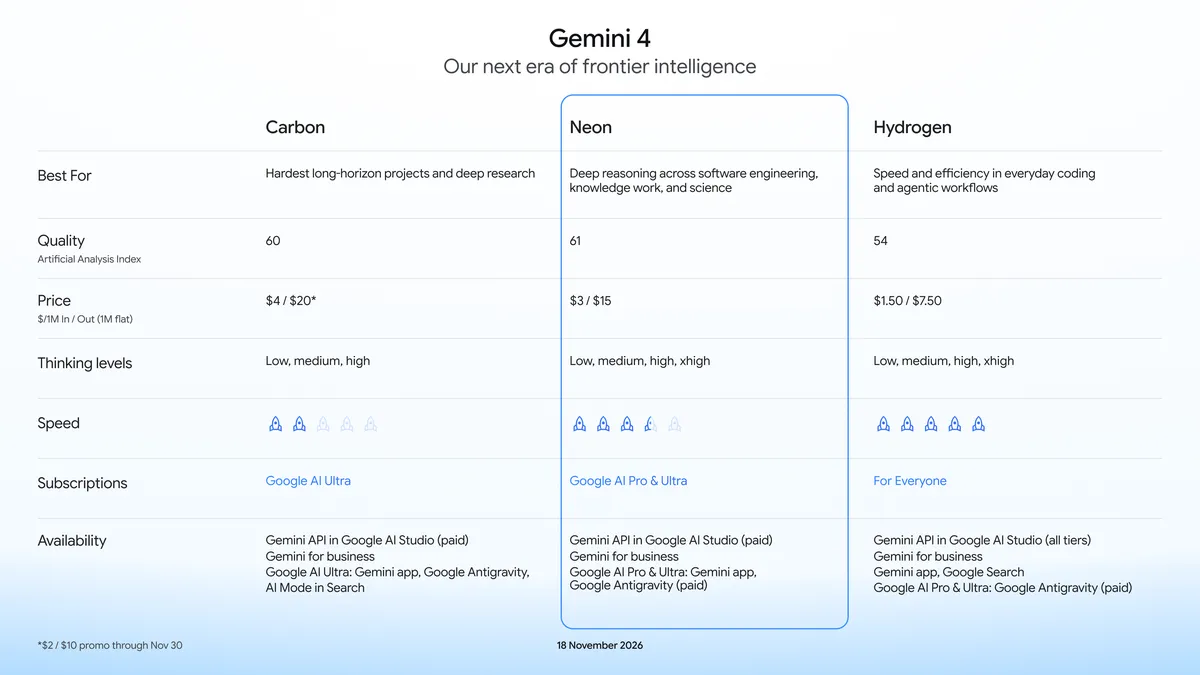
Google has launched Gemini 4 Neon, a model between Gemini 4 Hydrogen and Carbon, in the Gemini API, Antigravity and the Gemini app. It costs $3 per million input tokens and $15 per million output tokens, with a 1 million-token context window.
Google says Neon keeps the misuse and prompt-injection protections of Carbon while declining fewer legitimate tasks.
Tap a lens to see what this story means for you.
Liked this? The Brief brings you the whole day in tech, verified, every morning.
Two minutes, free forever. What's in The Brief →
See what’s happening right now
The Feed runs all day — short, verified briefs the moment they break.
Open the FeedFollow @thecircuitry_
Every story we publish, as it happens. No noise between.
Reader-supported
The Circuitry is a passion project I've always wanted to build, and I love the work behind it.
Running it costs real money. APIs, hosting, time. To keep improving the site and growing this into something useful for everyone, those costs have to be covered.
Any contribution is appreciated. If not, no pressure. Thanks for reading.
Google has launched a Robotics plugin for Antigravity that runs Gemini 4 Hydrogen on a supported arm. The plugin is limited to paid Google AI Pro and Ultra subscribers, and a demo arm was ready for tasks in about 10 minutes.
Google is rolling out Orchestrator in Antigravity for Google AI Ultra subscribers. It pairs Gemini 4 Carbon with Gemini 4 Hydrogen in one session, and on one test it used less quota and finished faster than Carbon alone.
Google has introduced Gemini 4 Hydrogen, priced at $1.50 per million input tokens and $7.50 per million output tokens. It is rolling out today in the Gemini app, Google Search, and the Gemini API, and it finishes tasks 2.5 times faster than Gemini 3.8 Flash at the default high setting.
Google has opened pre-orders for Intelligent Eyewear made with Warby Parker, Gentle Monster and Samsung, with prices from $395 and sales starting December 10. The Gemini glasses work with Pixel, Samsung and iPhone models, though some features need an Android phone at launch.
Google has linked a late-2025 data theft at a US organization to a 2026 intrusion at a second US organization by the Russian group COLD RELIC. Operators used stolen staff records from the first breach to impersonate an employee and phish the next target.