IBM says Nighthawk r3 is designed for 10,000 quantum operations on 520 programmable qubits, and that it plans to connect two of the chips into a 1,040-qubit system in 2027.
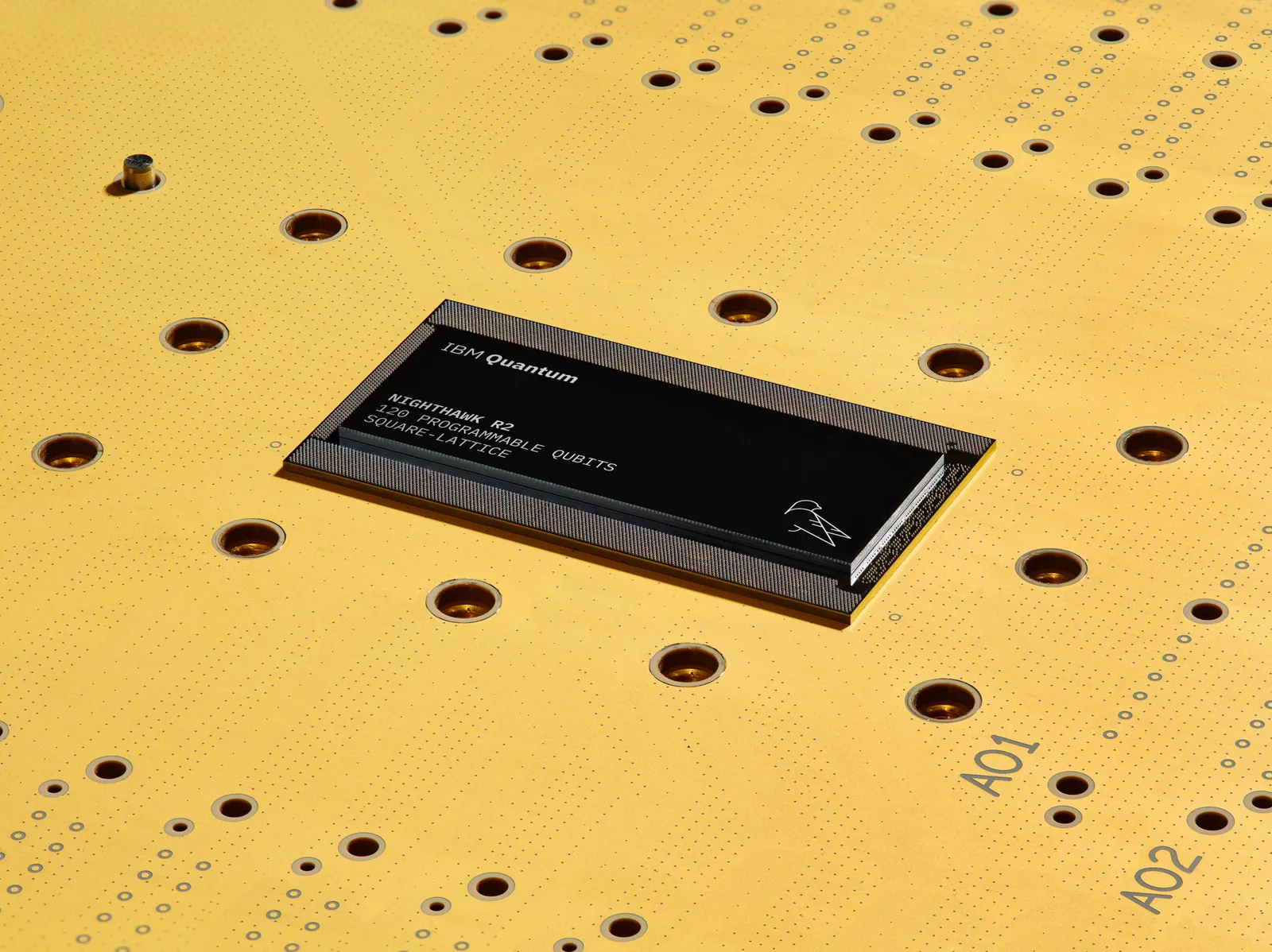
IBM says it plans to connect two Nighthawk r3 processors into a single 1,040-qubit system in 2027. The company says each new processor is designed to run 10,000 quantum operations on 520 programmable qubits.
The new chip is larger than the one shipping now. IBM says Nighthawk r3 will keep the square-lattice layout and fast operations of the current chip, and will add 10 chip-to-chip links, called l-couplers. It says the processor will have 2,034 physical qubits in all, of which 520 are programmable. The company says the current Nighthawk, introduced in September, delivers up to 100,000 samples a second and supports accurate computations with more than 7,500 operations on 120 qubits.
IBM has already tested the links it plans to use. The company says it connected Nighthawk r1 processors this year with four l-couplers and reached 99.3 percent state-transfer fidelity, against a target of 99.9 percent. It also says it connected two cryogenic modules into one system for the first time, reached operating temperature in under five days, and cooled the system below 15 millikelvin.
Partners have already run the current chip at scale. IBM says E.ON, Algorithmiq, and Q-CTRL have executed 34 billion circuits on Nighthawk r2, with reported speedups of up to 19 times versus earlier IBM quantum processors. E.ON reported a 15-times speedup in a quantum machine-learning job for grid optimization, measured against earlier work on IBM's Heron processor. IBM says an Oak Ridge National Laboratory materials experiment ran 12 times faster on r2 than on Heron, and an Algorithmiq materials simulation ran 8 times faster than the original Heron experiment.
The platform now pairs quantum jobs with classical computers. IBM says users can connect a quantum workflow to a laptop, a supercomputer, or classical resources on the IBM Quantum Platform. It says an IBM and RIKEN workflow ran about 5 times faster and performed 100 times more computations than the original study. Cleveland Clinic and RIKEN processed 608 million samples, which IBM says was 33 times faster than without the workflow automation.
"Useful quantum computing hinges on whether results can be delivered with accuracy and speed, both are fundamental," said Jay Gambetta, director of IBM Research and an IBM fellow.
Tap a lens to see what this story means for you.
Liked this? The Brief brings you the whole day in tech, verified, every morning.
Two minutes, free forever. What's in The Brief →
See what’s happening right now
The Feed runs all day — short, verified briefs the moment they break.
Open the FeedFollow @thecircuitry_
Every story we publish, as it happens. No noise between.
Reader-supported
The Circuitry is a passion project I've always wanted to build, and I love the work behind it.
Running it costs real money. APIs, hosting, time. To keep improving the site and growing this into something useful for everyone, those costs have to be covered.
Any contribution is appreciated. If not, no pressure. Thanks for reading.
Google says home keys in Wallet work with compatible Aliro locks in the Google Home app. Tap to unlock needs Android 9 or later. Wear OS watches are not supported at launch.
Google says the Gemini Decisions API is available in Google AI Studio, priced at $0.10 per million input tokens, with no charge for output tokens.
Amazon says AWS Emulator is available for download, that autonomous agents wrote every line, and that the team has not reviewed the code.
Google says the Gemini app is rolling out on Apple CarPlay starting today, for all Gemini users on iOS in every language Gemini Live already supports.
Databricks says the new always-on Genie is coming soon to preview and beta programs, while the current Genie and Genie Ontology are already generally available.

