The Circuitry
THE CIRCUITRYYour one-stop source for all tech news
HOMETODAYNEWSFEEDEVENTS
BOOKMARKS
RSS
© 2026 The Circuitry
About UsSourcesContactCorrectionsPrivacy
  • Today
  • Feed
  • Events
  • Saved
Scroll for more
Verification
VERIFIEDConfidence: HIGH
Source identified
Claims cross-referenced
No discrepancies found
Fact-check summary

Verified Oct 12 against Microsoft's official blog (Scott Guthrie, Oct 12, 2026): multi-gigawatt from 2027, primary inference system; Maia 200 in production (Copilot, MAI; GitHub Copilot/Foundry by year end; OpenAI/MAI/open models; US, Europe, Australia; up to 1.7x tokens/watt vs GPUs for Teams/Copilot/Cowork); Maia 300 40% more tokens/MW, up to 7x rack throughput vs Maia 200 in 96-accelerator config; 96 accelerators/167 kW, 27.6TB HBM, 1.7PB/s; 8 HBM4 stacks, 18.0TB/s, 950W TDP; production 2027. Fixes: 'multi-chiplet design on TSMC N2P' corrected to compute chiplets on N2P (blog says chiplets separate compute/memory-controller/IO, compute on N2P); dropped unsupported link of Maia 300 production to the multi-gigawatt expansion; attributed claims to Microsoft; tweet rewritten.

Sourcing
1source

via Microsoft

Markets
MSFT···

Live quote · not investment advice

From The CircuitryWhy The Circuitry

Verified tech news, cross-checked.

Every story is checked against independent sources before it posts — no rumors dressed up as fact.

How we verify →
Home/Tech/Microsoft to scale Azure Maia chips to multi-gigawatt deployments from 2027
VERIFIEDBy Xavier Rivera· ·1.5 min read

Microsoft to scale Azure Maia chips to multi-gigawatt deployments from 2027

Microsoft will scale its Azure Maia accelerators to multi-gigawatt deployments starting in 2027, making Maia its primary inference system. Maia 200 is in production now, and Microsoft expects Maia 300 to deliver 40% more tokens per megawatt than leading GPU systems.
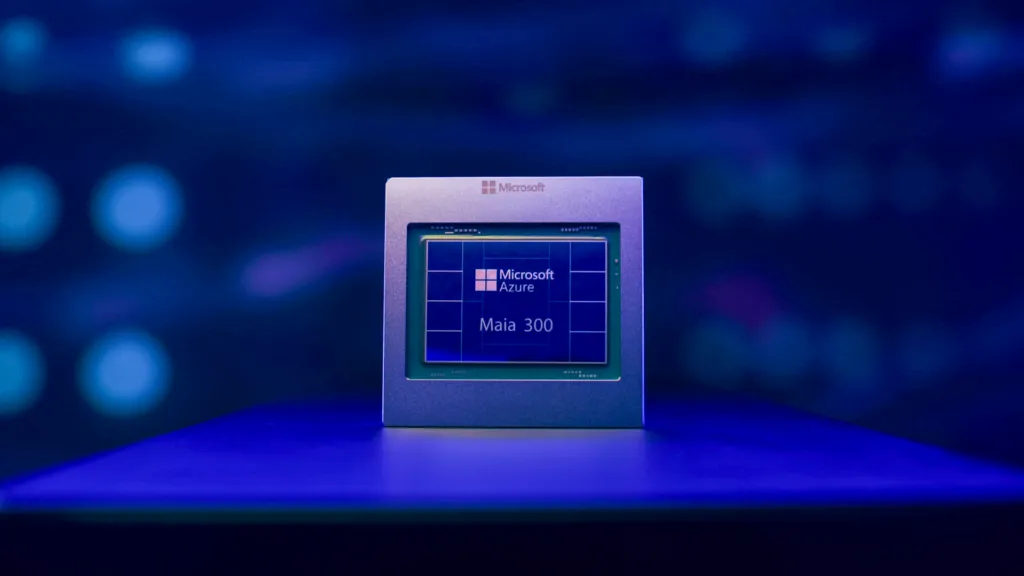
Source:Microsoft
Post
Microsoft to scale Azure Maia chips to multi-gigawatt deployments from 2027
From The CircuitryWhy The Circuitry

Verified tech news, cross-checked.

Every story is checked against independent sources before it posts — no rumors dressed up as fact.

How we verify →
Microsoft will scale its Azure Maia AI accelerator family to multi-gigawatt deployments starting in 2027, making Maia the primary inference system for Microsoft products and services, Cloud + AI chief Scott Guthrie wrote on October 12.

Maia 200 is already in production. Microsoft says Maia 200 now serves production workloads including Microsoft Copilot and supports the MAI team building next-generation models, with GitHub Copilot and Microsoft Foundry to follow by the end of the year. It runs OpenAI models, Microsoft's own MAI models and leading open-source model families, and is deploying across the United States, Europe and Australia.

Microsoft says Maia 200 delivers up to 1.7 times more tokens per watt than leading GPU infrastructure for built-in AI features in Microsoft Teams, Copilot and Cowork.
From The CircuitryThe Feed — live briefs across tech, all day.See what’s happening →
Maia 300 targets agents and long context. The next generation is built inference-first for long-context reasoning, latency-sensitive conversations and sustained multi-step agentic tasks. Microsoft expects it to deliver 40% more tokens per megawatt than leading GPU-based systems, and up to seven times the rack-scale token throughput of Maia 200 in a full 96-accelerator configuration.

The rack and chip specs. Each Maia 300 rack holds 96 accelerators within a 167-kilowatt power envelope, with 27.6TB of HBM capacity and 1.7PB/s of aggregate HBM bandwidth. Each accelerator has eight HBM4 stacks providing 18TB/s of peak memory bandwidth within a 950-watt TDP. It uses a new multi-chiplet design, with compute chiplets built on TSMC's N2P process.
From The CircuitryWhy The Circuitry

Verified tech news, cross-checked.

Every story is checked against independent sources before it posts — no rumors dressed up as fact.

How we verify →
Production starts in 2027. Maia 300 will begin production deployments in 2027. Microsoft says it will share more at Ignite 2026 next month.
Why this mattersAI · ~100 words

Tap a lens to see what this story means for you.

Morning Brief

Liked this? The Brief brings you the whole day in tech, verified, every morning.

Two minutes, free forever. What's in The Brief →

Reader-supported
DonateBuy me a coffee →Follow@thecircuitry_ →Follow@thecircuitry.to →
HELP US IMPROVE
From The Circuitry

See what’s happening right now

The Feed runs all day — short, verified briefs the moment they break.

Open the Feed →
From The Circuitry

Follow @thecircuitry_

Every story we publish, as it happens. No noise between.

Follow on X ↗On Bluesky ↗

Reader-supported

The Circuitry is a passion project I've always wanted to build, and I love the work behind it.

Running it costs real money. APIs, hosting, time. To keep improving the site and growing this into something useful for everyone, those costs have to be covered.

Any contribution is appreciated. If not, no pressure. Thanks for reading.

Buy me a coffee
More inTech
  • Apple Plans Two-Day Creator Showcase for New Macs and iPad Mini, Gurman Reports

    Tech · 9h
  • Bloomberg: Apple readies extensive demo rollout for foldable iPhone Duo

    Tech · 11h
SupportThe Work

The Circuitry is reader-supported. If you find the daily brief useful, you can buy me a coffee to keep it going.

Buy a coffee →
From The CircuitryWhy The Circuitry

Verified tech news, cross-checked.

Every story is checked against independent sources before it posts — no rumors dressed up as fact.

How we verify →

MORE IN THIS BEAT

All Tech →
  • Tech· 

    SAP discloses four critical flaws, including a 10.0 in its Cloud SDK for Python

    SAP has published CVE records for four critical flaws: CVE-2026-89111 in the Cloud SDK for Python (10.0), CVE-2026-89107 in S/4HANA (9.9), CVE-2026-89110 in NetWeaver Visual Composer (9.9) and CVE-2026-89108 in Manufacturing Integration and Intelligence (9.1). The scores come from SAP.

  • Tech· 

    What to expect from Apple's Oct. 13 'Welcome home' event

    Apple's "Welcome home" event is Tuesday, Oct. 13. According to Bloomberg reporting compiled by 9to5Mac, it is expected to bring a HomeView smart display, a new Apple TV 4K, and a HomePod mini 2. Apple has not confirmed any products.

  • Tech· 

    Three more 9.6-rated IBM DataStage flaws get CVE records; IBM's fix is already out

    NVD published records for three IBM DataStage on Cloud Pak for Data 5.4.0.0 vulnerabilities (CVE-2026-82101, CVE-2026-82103, CVE-2026-82110) that IBM rates 9.6 CVSS. They are covered by IBM's Sept. 21 bulletin, which says to upgrade to 5.4 patch 7 or later.

  • Tech· 

    IBM Db2 Mirror for i hit by critical privilege escalation flaw

    IBM disclosed CVE-2026-96012, a privilege escalation flaw in Db2 Mirror for i versions 7.4, 7.5, and 7.6 that IBM rates 9.9 CVSS. An authenticated attacker could bypass checks to execute malicious code and gain elevated privileges. Fixes are available.

  • Tech· 

    Critical CVE-2026-90920 hits IBM Maximo AI Service 9.1.0 and 9.2.0

    IBM Maximo AI Service 9.1.0 and 9.2.0 are affected by CVE-2026-90920, a code-injection flaw IBM rates 9.8 CVSS. A remote attacker could execute arbitrary code. IBM says to upgrade to 9.1.19 or 9.2.3.