The Circuitry
THE CIRCUITRYYour one-stop source for all tech news
HOMETODAYNEWSFEEDEVENTS
BOOKMARKS
RSS
© 2026 The Circuitry
About UsSourcesContactCorrectionsPrivacy
  • Today
  • Feed
  • Events
  • Saved
Scroll for more
Verification
VERIFIEDConfidence: HIGH
Source identified
Claims cross-referenced
No discrepancies found
Fact-check summary

Multiple NASA reports and SpaceNews confirm the Aug. 30 Falcon Heavy launch of the Roman Space Telescope from KSC at 7:26 a.m. EDT.

Sourcing
1source

via NASASpaceflight

NASASpaceflight · track record
2Stories
100%Verified
130d
All sources →
From The CircuitryWhy The Circuitry

Verified tech news, cross-checked.

Every story is checked against independent sources before it posts — no rumors dressed up as fact.

How we verify →
Home/Tech/NASA and SpaceX Prepare for Nancy Grace Roman Space Telescope Launch
VERIFIEDBy Xavier Rivera· ·2.5 min read

NASA and SpaceX Prepare for Nancy Grace Roman Space Telescope Launch

NASA and SpaceX are targeting a 7:26 AM EDT Sunday liftoff of a Falcon Heavy from Kennedy Space Center carrying the Nancy Grace Roman Space Telescope. The observatory will travel to Sun-Earth L2, where its Wide Field and Coronagraph instruments will search for exoplanets and study dark energy.
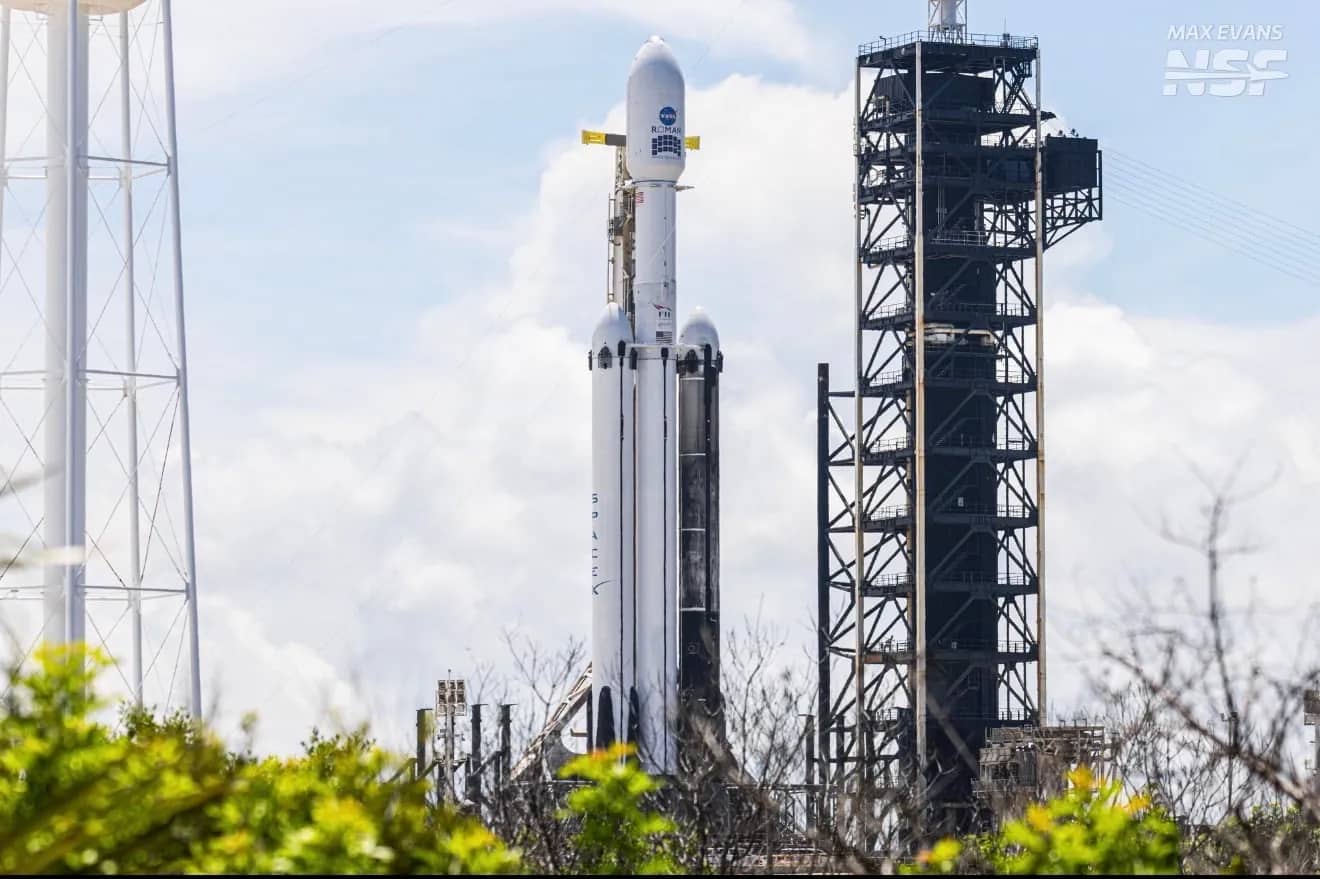
Source:NASASpaceflight
Post
NASA and SpaceX Prepare for Nancy Grace Roman Space Telescope Launch
From The CircuitryWhy The Circuitry

Verified tech news, cross-checked.

Every story is checked against independent sources before it posts — no rumors dressed up as fact.

How we verify →
TL;DRAI · 60 sec read

NASA and SpaceX prepare to launch the Nancy Grace Roman Space Telescope on a Falcon Heavy rocket from Kennedy Space Center Sunday at 7:26 AM EDT. The observatory will reach Sun-Earth L2 in one month and use its wide-field and coronagraph instruments to search for exoplanets and study dark energy.

NASA has teamed with SpaceX to send the Nancy Grace Roman Space Telescope into space atop a Falcon Heavy rocket from Florida on Sunday.
Falcon Heavy vertical at LC-39A ahead of Nancy Grace Roman Space Telescope launch
Falcon Heavy vertical at LC-39A ahead of Nancy Grace Roman Space Telescope launch · SpaceX
The launch is scheduled for Sunday morning from Kennedy Space Center. Liftoff from Launch Complex 39A at the Kennedy Space Center in Cape Canaveral, Florida, is targeted for 7:26 AM EDT (11:26 UTC). After separating from the rocket, the observatory will require approximately one month to reach the Sun-Earth Lagrange Point 2.
Although building a telescope from scratch would probably have cost less, adopting the NRO hardware lent the project added political weight.
During that transit, engineers will commission the telescope and ready its systems for science operations. Falcon Heavy’s two side boosters are slated to return for landings at separate zones on Cape Canaveral Space Force Station, while the center core will be expended to provide the extra performance required for the heavy payload.
POST FROM @SpaceX· Official announcement and photos/video of Falcon Heavy rollout and vertical stack at LC-39A for Roman launch
https://x.com/SpaceX/status/2093791531505184932
Roman carries two instruments for its science mission at L2. Once at its destination in a halo orbit around the Sun-Earth Lagrange Point 2, the observatory will rely on the Wide Field Instrument and the Coronagraph Instrument to hunt for exoplanets, probe dark energy, and investigate other astrophysical phenomena.
From The CircuitryThe Feed — live briefs across tech, all day.See what’s happening →
The mission traces its origins to a 2010 decadal survey recommendation. That year the U.S. National Research Council Decadal Survey placed the Wide-Field Infrared Survey Telescope, known as WFIRST, at the top of NASA’s astronomy priorities for the coming decade. Early concepts resembled elements of the earlier proposed Joint Dark Energy Mission and called for a 1.3 m three-mirror anastigmat design paired with a single-prism spectrometer.
Falcon Heavy’s two side boosters are slated to return for landings at separate zones on Cape Canaveral Space Force Station, while the center core will be expended to provide the extra performance required for the heavy payload.
In 2012 the National Reconnaissance Office supplied NASA with two surplus Harris Corporation telescopes. One of those instruments, possessing a mirror equal in diameter to Hubble’s yet offering a wider field of view because of its shorter focal length, was ultimately chosen. Although building a telescope from scratch would probably have cost less, adopting the NRO hardware lent the project added political weight.
From The CircuitryWhy The Circuitry

Verified tech news, cross-checked.

Every story is checked against independent sources before it posts — no rumors dressed up as fact.

How we verify →
Development milestones stretched from 2015 through 2021. Mission planners spent 2015 evaluating a geosynchronous orbit versus placement at L2, weighing observing constraints, thermal stability, and future servicing possibilities before settling on a halo orbit at L2 in February 2016. NASA assigned construction and operations to its Goddard Space Flight Center in Greenbelt, Maryland, in November 2018. A white paper detailing the mission’s capabilities appeared in February 2019, followed by formal approval for implementation and construction the following March. NASA Administrator Jim Bridenstine revealed the new name—the Nancy Grace Roman Space Telescope—in May 2020 to honor the agency’s first female executive and Chief of Astronomy. The project cleared its critical design review the next year.
Why this mattersAI · ~100 words

Tap a lens to see what this story means for you.

Reader-supported
DonateBuy me a coffee →Follow@thecircuitry_ →Follow@thecircuitry.to →

Reader-supported · The Brief

Liked this? The Brief brings you the whole day in tech, verified, every morning. Two minutes, free forever.

HELP US IMPROVE
From The Circuitry

See what’s happening right now

The Feed runs all day — short, verified briefs the moment they break.

Open the Feed →
From The Circuitry

Follow @thecircuitry_

Every story we publish, as it happens. No noise between.

Follow on X ↗On Bluesky ↗

Reader-supported

The Circuitry is a passion project I've always wanted to build, and I love the work behind it.

Running it costs real money. APIs, hosting, time. To keep improving the site and growing this into something useful for everyone, those costs have to be covered.

Any contribution is appreciated. If not, no pressure. Thanks for reading.

Buy me a coffee
SpaceNASASpaceXLaunch
More fromNASASpaceflight
  • NASA Awards Four New Lunar Lander Contracts for Moon Base

    Tech · 1mo
More inTech
  • Carhartt data breach exposes 12.9 million accounts

    Tech · 2d
  • Nvidia Agrees to Acquire Hugging Face for $12.9 Billion

    Tech · 2d
  • Meta Agrees to $16.68 Billion Settlement in US Youth Addiction Case

    Tech · 3d
SupportThe Work

The Circuitry is reader-supported. If you find the daily brief useful, you can buy me a coffee to keep it going.

Buy a coffee →
SubscribeCircuitry Brief

Liked this? The Brief brings you the whole day in tech, verified, every morning. Free forever.

From The CircuitryWhy The Circuitry

Verified tech news, cross-checked.

Every story is checked against independent sources before it posts — no rumors dressed up as fact.

How we verify →

MORE IN TECH

Carhartt data breach exposes 12.9 million accounts

ShinyHunters published data from 12.9 million genuine Carhartt accounts after the apparel company refused a $3.3 million ransom. The breach, which also exposed records for more than 15,000 employees, originated from Carhartt's Databricks analytics platform.

Nvidia Agrees to Acquire Hugging Face for $12.9 Billion

Nvidia has agreed to acquire open-source AI platform Hugging Face for $12.9 billion according to The Information. The deal would expand Nvidia's reach into the software and model ecosystem while highlighting its bet on continued AI demand growth.

Meta Agrees to $16.68 Billion Settlement in US Youth Addiction Case

Meta has agreed to pay up to $16.68 billion to settle a U.S. lawsuit from 29 states accusing it of making Facebook and Instagram addictive for teens while also implementing new safeguards on adolescent accounts. The settlement denies wrongdoing but sets nationwide defaults like two-hour daily limits and chronological feeds, closing one front in Meta's ongoing legal battles over youth mental health.