SpaceX is targeting Friday morning for NROL-179, its third 2026 flight supporting the National Reconnaissance Office’s proliferated architecture constellation of intelligence satellites believed to be Starshield variants. The booster on its third flight will attempt a landing at Vandenberg’s Landing Zone 4.
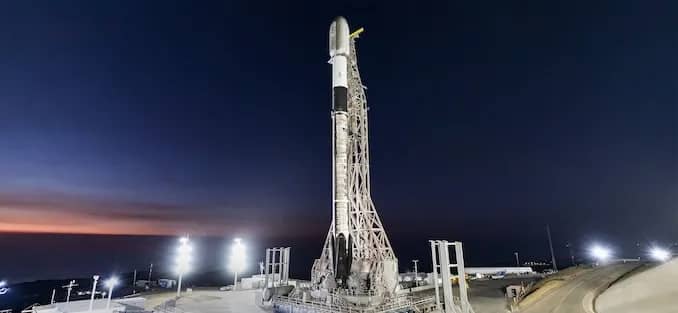
Neither the NRO nor SpaceX has confirmed on the record that these are government-modified versions of the Starlink design.
Those relay satellites also support inter-satellite optical links that form part of both the NRO’s resilient communications network and the Department of War’s planned Space-Data Network.
Tap a lens to see what this story means for you.
Liked this? The Brief brings you the whole day in tech, verified, every morning.
Two minutes, free forever. What's in The Brief →
See what’s happening right now
The Feed runs all day — short, verified briefs the moment they break.
Open the FeedFollow @thecircuitry_
Every story we publish, as it happens. No noise between.
Reader-supported
The Circuitry is a passion project I've always wanted to build, and I love the work behind it.
Running it costs real money. APIs, hosting, time. To keep improving the site and growing this into something useful for everyone, those costs have to be covered.
Any contribution is appreciated. If not, no pressure. Thanks for reading.
NASA awarded SpaceX a $946 million contract for three more crewed missions to the ISS, bringing the company's total under the deal to 17 flights through 2030 and the contract value to $5.92 billion. The expansion helps NASA sustain access to the station while Boeing prepares its Starliner for crewed operations.
SpaceX has delayed the first orbital Starship flight from September 22 to September 28 pending regulatory approval. The mission will attempt to place 26 V3 Starlink satellites into a 275 km orbit and marks a key milestone after the program's initial test flight in 2023.
NASA and SpaceX are targeting a 7:26 AM EDT Sunday liftoff of a Falcon Heavy from Kennedy Space Center carrying the Nancy Grace Roman Space Telescope. The observatory will travel to Sun-Earth L2, where its Wide Field and Coronagraph instruments will search for exoplanets and study dark energy.
SpaceX has completed its $60 billion acquisition of AI coding startup Cursor, granting the company access to the world's largest GPU fleet for lower-cost model development. The deal, which began with an April partnership and follows SpaceX's merger with xAI, has already produced Grok 4.5 and 4.6 focused on coding and real-world tasks.
Tesla and SpaceX have confirmed Grimes County, Texas as the site for their Terafab semiconductor megafactory, with the first phase costing roughly $16.8 billion. The project targets the largest chip manufacturing facility on the planet to supply over 1 terawatt of compute per year that exceeds current and future global production capacity.