AWS launched S3 annotations that attach up to 1 GB of mutable, queryable context per object in formats such as JSON and XML. The capability eliminates separate metadata systems for AI agents by automatically propagating context with objects and enabling direct queries via Athena without retrieval charges for any storage class.
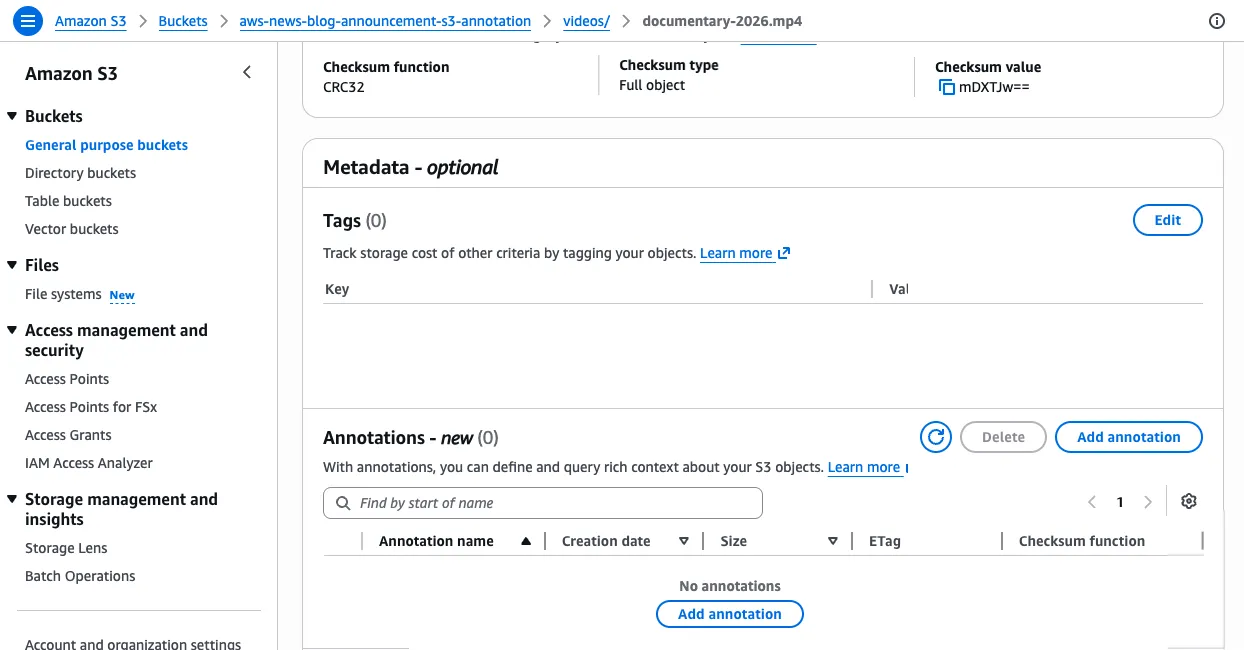
The capability targets AI agents and autonomous workflows that locate, interpret and operate on data independently.
Previously, comparable detail lived in separate databases or companion files, generating synchronization costs that sometimes surpassed storage itself.
Tap a lens to see what this story means for you.
Liked this? The Brief brings you the whole day in tech, verified, every morning.
Two minutes, free forever. What's in The Brief →
See what’s happening right now
The Feed runs all day — short, verified briefs the moment they break.
Open the FeedFollow @thecircuitry_
Every story we publish, as it happens. No noise between.
Reader-supported
The Circuitry is a passion project I've always wanted to build, and I love the work behind it.
Running it costs real money. APIs, hosting, time. To keep improving the site and growing this into something useful for everyone, those costs have to be covered.
Any contribution is appreciated. If not, no pressure. Thanks for reading.
AWS Builder Center has completed its first year with expanded features including sandbox environments, while Security Hub gains network scanning and Azure support. These updates strengthen community building, security posture management, and machine learning workflows for AWS users.
AWS has launched a Forward Deployed Engineering organization backed by a $1 billion investment to embed thousands of AI experts with customers for rapid agentic AI deployments. The model compresses timelines from months to days and builds lasting self-sufficiency so customers can operate independently after engagements end.
Anthropic’s Claude models in Microsoft Foundry are now generally available on Microsoft Azure running on NVIDIA GB300 Blackwell Ultra GPUs. This gives Azure-native enterprises a new platform for building autonomous and domain-specific AI agents with enhanced performance and governed security.
Amazon will allocate $13 billion to expand AI and cloud infrastructure in Mumbai and Hyderabad, part of a five-year commitment exceeding $48 billion that aligns with national goals around AI access, small-business digitization, jobs and exports. The outlay contributes to the company's projected $200 billion global capital expenditure in 2026.
Anthropic has introduced Claude Tag for Slack, enabling the model to act as a proactive colleague that joins discussions, handles tasks in sequence, posts results in threads, operates in ambient mode and schedules its own reminders. Internally the company now generates 65 percent of its code with the tool while administrators retain token caps to manage spending.