The Circuitry
THE CIRCUITRYYour one-stop source for all tech news
HOMETODAYNEWSFEEDEVENTS
BOOKMARKS
RSS
© 2026 The Circuitry
About UsSourcesContactCorrectionsPrivacy
  • Today
  • Feed
  • Events
  • Saved
Scroll for more
Verification
VERIFIEDConfidence: HIGH
Source identified
Claims cross-referenced
No discrepancies found
Fact-check summary

Reported directly by AWS Blog — the official primary source for this announcement.

Sourcing
1source

via AWS Blog

AWS Blog · track record
4Stories
100%Verified
430d
All sources →
Markets
AMZN···

Live quote · not investment advice

Home/Tech/AWS Lambda Introduces MicroVMs for Isolated, Stateful Sandboxes
VERIFIEDBy Xavier Rivera· ·2.5 min read

AWS Lambda Introduces MicroVMs for Isolated, Stateful Sandboxes

AWS announced Lambda MicroVMs, a new serverless primitive offering VM-level isolation, rapid launch, state preservation up to session length, and full lifecycle control without infrastructure management. It fills the gap for multi-tenant apps that must safely run untrusted user or AI code in dedicated environments while delivering low-latency experiences.
Source:AWS Blog
Post
AWS Lambda Introduces MicroVMs for Isolated, Stateful Sandboxes
TL;DRAI · 60 sec read

AWS launches Lambda MicroVMs, a serverless option that runs user or AI code in isolated, stateful Firecracker VMs. The feature supplies VM-grade separation with fast startup, session persistence, and no server management for workloads like coding sandboxes and analytics platforms that need private runtimes.

AWS announced the launch of Lambda MicroVMs, a fresh serverless compute option inside its Lambda service. The capability enables running code supplied by end users or generated through AI inside dedicated execution environments that stay isolated and preserve state throughout each session.

AWS Lambda MicroVMs deliver VM isolation without infrastructure management. Developers receive virtual-machine-grade separation, near-instant startup and resumption, plus complete authority over the environment's lifecycle and internal state. No underlying servers need direct oversight and no specialized knowledge of advanced virtualization is required.

These MicroVMs rely on Firecracker, the same lightweight virtualization layer that has already supported more than 15 trillion monthly Lambda function invocations.
AWS Lambda MicroVMs deliver VM isolation without infrastructure management.

New class of multi-tenant applications drives demand for isolated execution. A growing category of workloads—including AI coding assistants, interactive coding sandboxes, data analytics platforms, vulnerability scanners, and game servers executing user-provided scripts—requires that each end user receive a private runtime. Traditional virtual machines supply robust boundaries yet often need minutes to boot. Containers start within seconds but rely on a shared kernel that demands extensive custom security hardening when handling untrusted code.

Serverless functions work well for short event-driven requests yet lack native support for extended interactive sessions that must carry forward memory and disk contents between user actions. Consequently, teams either tolerate compromises on speed versus safety or devote substantial engineering effort toward custom virtualization stacks.
From The CircuitryThe Feed — live briefs across tech, all day.See what’s happening →

MicroVMs address the isolation-performance gap with state retention. Each instance grants one user or session a fully separated environment that starts quickly, holds memory and disk contents for the entire duration, and suspends to minimal cost during inactivity. Because the underlying Firecracker technology already runs at massive scale inside Lambda, the new option benefits from proven operational reliability.
New class of multi-tenant applications drives demand for isolated execution.

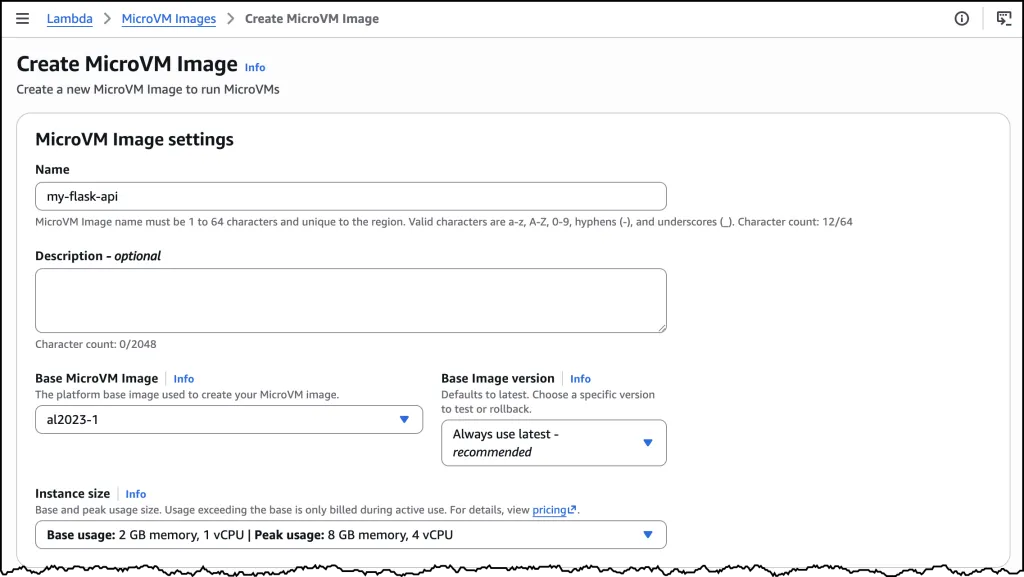
Getting started requires creating a MicroVM Image from code artifacts. Inside the AWS Lambda console the new MicroVMs section now sits in the left navigation. Builders begin by bundling an application together with its Dockerfile into a zip archive, then uploading that archive to an Amazon S3 bucket. The image can be built either through the AWS CLI command or directly in the console.

The command needs a code artifact URI, chosen image name, base image ARN such as arn:aws:lambda:us-east-1:aws:microvm-image:al2023-1, and an IAM build role ARN. Once launched, Lambda fetches the zip, executes the Dockerfile instructions, starts the application, captures a Firecracker snapshot of live memory and disk, and streams build logs live into Amazon CloudWatch under the /aws/lambda/microvms prefix.

An included example shows a minimal Flask API served by Gunicorn from a Dockerfile derived from the public.ecr.aws/lambda/microvms:al2023-minimal base that installs Python packages before exposing port 5000.
Why this mattersAI · ~100 words

Tap a lens to see what this story means for you.

Reader-supported
DonateBuy me a coffee →Follow@thecircuitry_ →Follow@thecircuitry.to →

Reader-supported · Daily Brief

Daily brief at 7 AM ET. Top tech stories, every morning. Sourced and fact-checked.

HELP US IMPROVE
From The Circuitry

See what’s happening right now

The Feed runs all day — short, verified briefs the moment they break.

Open the Feed →
From The Circuitry

Follow @thecircuitry_

Every story we publish, as it happens. No noise between.

Follow on X ↗On Bluesky ↗

Reader-supported

The Circuitry is a passion project I've always wanted to build, and I love the work behind it.

Running it costs real money. APIs, hosting, time. To keep improving the site and growing this into something useful for everyone, those costs have to be covered.

Any contribution is appreciated. If not, no pressure. Thanks for reading.

Buy me a coffee
AWSLambdaServerless
More fromAWS Blog
  • Amazon S3 annotations attach up to 1 GB of mutable context per object

    Tech · 6d
  • AWS Launches Graviton5-Powered EC2 M9g Instances

    Tech · 12d
  • OpenAI GPT-5.5, GPT-5.4 and Codex Now Generally Available on Bedrock

    Tech · 21d
More inTech
  • Meta pauses employee-tracking AI after internal data leak

    Tech · 7h
  • SpaceX Announces First Bond Offering After Blockbuster IPO

    Tech · 12h
  • DeepMind partners with A24 on AI film tools after Google invests $75 million

    Tech · 13h
SupportThe Work

The Circuitry is reader-supported. If you find the daily brief useful, you can buy me a coffee to keep it going.

Buy a coffee →
SubscribeCircuitry Brief

Daily brief at 7 AM ET. Top tech stories, every morning.

MORE IN TECH

Meta pauses employee-tracking AI after internal data leak

Meta has paused its Model Capability Initiative AI training program after sensitive employee data including private conversations and performance metrics became visible to the entire company. The incident adds to a string of recent AI-related cybersecurity issues and is expected to heighten controversy around the firm's employee-monitoring practices.

SpaceX Announces First Bond Offering After Blockbuster IPO

SpaceX disclosed approximately $100.8 billion in cash while launching its first bond sale days after an IPO that raised nearly $86 billion. Proceeds will repay bridge financing and back the firm's ambitious AI and space-based data center expansion.

DeepMind partners with A24 on AI film tools after Google invests $75 million

DeepMind is collaborating with A24 to create AI systems for film production and distribution. The business daily reported that Google is investing around $75 million in the studio, marking its first equity stake in a movie company. The non-exclusive multiyear agreement stresses artist-guided development while surfacing Hollywood worries about training data and alleged copyright issues.