The Circuitry
THE CIRCUITRYYour one-stop source for all tech news
HOMETODAYNEWSFEEDEVENTS
BOOKMARKS
STARTING SOONgamescom Opening Night Live 2026IN 1HOpen coverage →
RSS
© 2026 The Circuitry
About UsSourcesContactCorrectionsPrivacy
  • Today
  • Feed
  • Events
  • Saved
Scroll for more
Verification
VERIFIEDConfidence: HIGH
Source identified
Claims cross-referenced
No discrepancies found
Fact-check summary

Multiple outlets (The Verge, WIRED, Apple Newsroom) confirm Apple's Aug 25 launch of M6 (first 2nm chip) and M5 Ultra (quad-die) in new Mac mini and Studio.

Sourcing
1source

via 9to5Mac

9to5Mac · track record
70Stories
100%Verified
330d
All sources →
Markets
AAPL···

Live quote · not investment advice

Home/Tech/Apple launches its first 2nm M6 chip and quad-die M5 Ultra
VERIFIEDBy Xavier Rivera· ·3 min read

Apple launches its first 2nm M6 chip and quad-die M5 Ultra

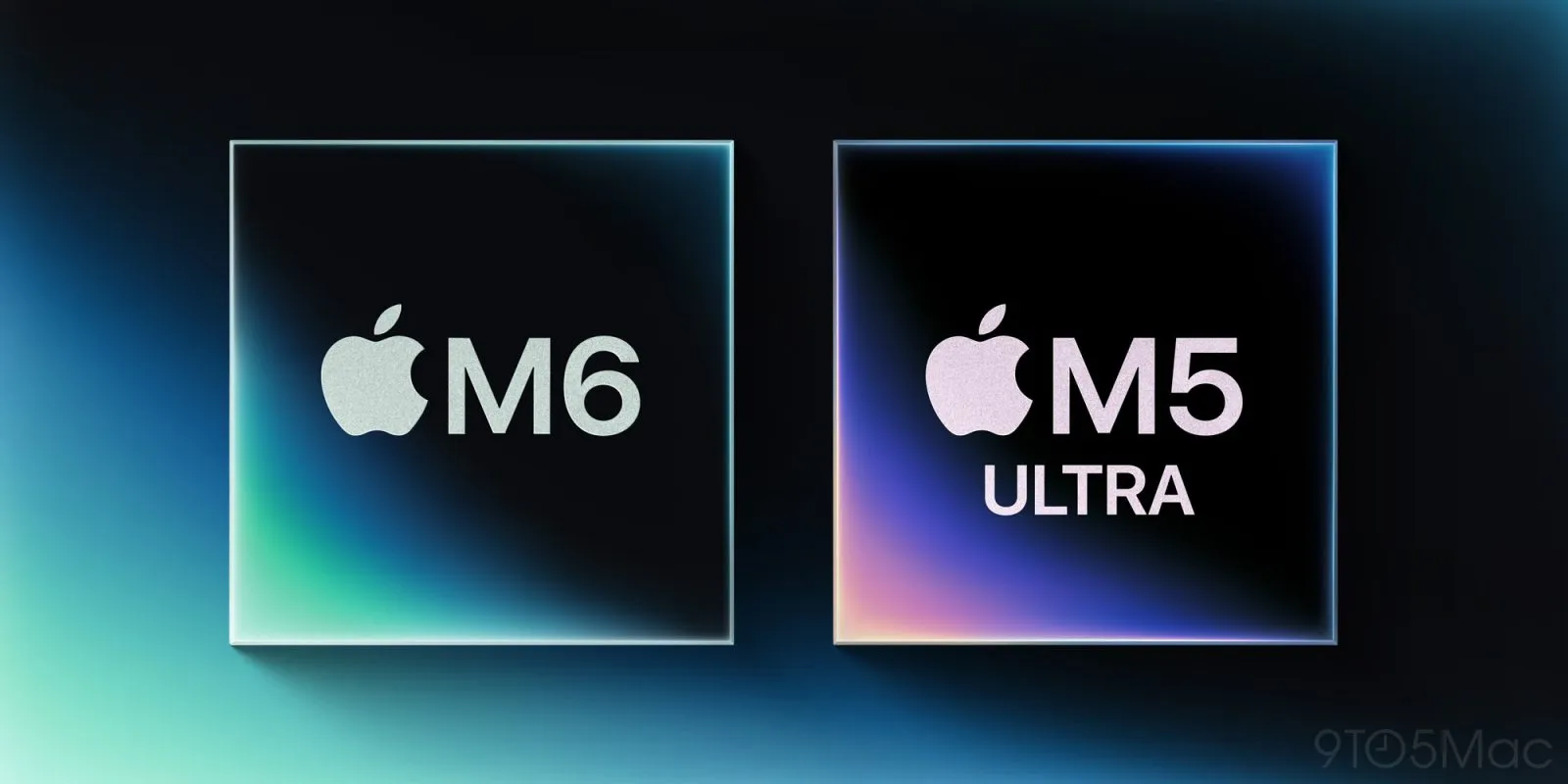
Apple introduced the M6 as its first 2nm processor inside a new Mac mini and the M5 Ultra as its most powerful chip yet inside a refreshed Mac Studio. The silicon brings higher core counts, substantially improved AI acceleration, increased memory bandwidth, and a next-generation UltraFusion interconnect.
Source:9to5Mac
Post
Apple launches its first 2nm M6 chip and quad-die M5 Ultra
TL;DRAI · 60 sec read

Apple introduced the M6 and M5 Ultra processors on Tuesday. The M6, Apple’s first 2nm chip, powers a redesigned Mac mini with a 12-core CPU and GPU. The M5 Ultra uses a quad-die design in a refreshed Mac Studio. These chips raise CPU, GPU, and AI performance with better efficiency and higher memory bandwidth than prior generations.

Apple introduced the M6 and M5 Ultra processors on Tuesday. The M6 debuts inside a redesigned Mac mini as the company’s first processor built on a 2nm process, while the M5 Ultra powers a refreshed Mac Studio and is described by Apple as its most powerful chip ever.

The M6 becomes Apple's first 2-nanometer processor. The company reports that the node delivers higher transistor density together with better power efficiency. Those gains reportedly let engineers expand compute resources without enlarging the die.

A 12-core CPU sits at the heart of the M6, two cores more than the M5. The design marks Apple’s first processor to combine all three core types: two super cores focused on peak single-threaded speed, four performance cores tuned for intensive multithreaded workloads, and six efficiency cores that manage lighter background tasks. Apple claims the configuration achieves “the world’s fastest single-threaded performance” and delivers “up to 1.2x faster multithreaded performance as compared to M5.”
The M6 becomes Apple's first 2-nanometer processor.

M6 GPU and memory see targeted upgrades. The GPU scales to 12 cores, each equipped with a dedicated Neural Accelerator, producing a 30 percent rise in peak GPU compute for AI workloads versus the M5. Additional refinements target the shader core architecture, Dynamic Caching, and hardware-accelerated ray tracing. Memory support reaches 32 GB of unified RAM at up to 170 GB/s bandwidth, an improvement Apple pegs at 10 percent over the M5. The chip also adds native hardware processing of the FP8 data format, an 8-bit standard intended to accelerate AI tasks while reducing memory demands.
POST FROM @9to5mac· outlet tweet directly linking and referencing the article
https://x.com/9to5mac/status/2092235705212616835

Benchmarks position M6 ahead of prior generations. Official figures show multithreaded CPU performance climbing as much as 1.2x over the M5 and 2.4x over the M1. Peak GPU compute for AI is nearly 30 percent higher than the M5 and more than 8x that of the M1. Geometry throughput for complex graphics rises 50 percent, while the dual 16-core Neural Engine supplies up to 2x the peak compute of earlier generations. Memory bandwidth hits 170 GB/s, 10 percent above the M5 and 2.5x the M1.
From The CircuitryThe Feed — live briefs across tech, all day.See what’s happening →

M5 Ultra adopts a quad-die architecture. The new flagship links two dual-die M5 Max chips through next-generation UltraFusion interconnect technology. Apple states the revised link supplies more than 4.4 TB/s of inter-die bandwidth and over 6x higher connection density, enabling all four dies to function as one unified processor.
The company again calls the M5 Ultra its “most powerful chip ever.”

The M5 Ultra CPU scales to 36 cores comprising 12 super cores and 24 performance cores. Relative to the M3 Ultra, Apple cites gains of up to 1.25x in single-threaded performance and 1.3x in multithreaded performance. The company again calls the M5 Ultra its “most powerful chip ever.”

M5 Ultra GPU and memory scale significantly higher. Graphics reach up to 80 cores, each carrying a Neural Accelerator. Apple projects up to 4.5x higher peak GPU compute for AI versus the M3 Ultra and as much as 40 percent faster overall graphics performance. The GPU incorporates the latest shader core with second-generation dynamic caching, hardware-accelerated mesh shading, and third-generation ray tracing. Unified memory tops out at 512 GB with 1.2 TB/s of bandwidth, a 50 percent increase over the M3 Ultra. GPU AI compute is listed at more than 6x the level of the M1 Ultra.
Both chips are available immediately in their respective new desktop systems.
Why this mattersAI · ~100 words

Tap a lens to see what this story means for you.

Reader-supported
DonateBuy me a coffee →Follow@thecircuitry_ →Follow@thecircuitry.to →

Reader-supported · The Brief

Liked this? The Brief brings you the whole day in tech, verified, every morning. Two minutes, free forever.

HELP US IMPROVE
From The Circuitry

See what’s happening right now

The Feed runs all day — short, verified briefs the moment they break.

Open the Feed →
From The Circuitry

Follow @thecircuitry_

Every story we publish, as it happens. No noise between.

Follow on X ↗On Bluesky ↗

Reader-supported

The Circuitry is a passion project I've always wanted to build, and I love the work behind it.

Running it costs real money. APIs, hosting, time. To keep improving the site and growing this into something useful for everyone, those costs have to be covered.

Any contribution is appreciated. If not, no pressure. Thanks for reading.

Buy me a coffee
AppleApple SiliconMac
More from9to5Mac
  • OpenAI outage takes down ChatGPT logins and new account creation

    Tech · 5d
  • Tim Cook Marks End of His Tenure Leading Apple Earnings Calls

    Tech · 25d
  • Apple tests AI for Genius Bar, sends letters to ex-staff at OpenAI

    Tech · 1mo
More inTech
  • Taiwan indicts 9 in Nvidia, Supermicro AI server smuggling case

    Tech · 5h
  • CISA Adds CVE-2026-21962 to Known Exploited Vulnerabilities Catalog

    Tech · 21h
  • XPeng Robotics Secures Over $900 Million at $6.3 Billion Valuation

    Tech · 1d
SupportThe Work

The Circuitry is reader-supported. If you find the daily brief useful, you can buy me a coffee to keep it going.

Buy a coffee →
SubscribeCircuitry Brief

Liked this? The Brief brings you the whole day in tech, verified, every morning. Free forever.

MORE IN TECH

Taiwan indicts 9 in Nvidia, Supermicro AI server smuggling case

Taiwan indicted nine people including an Nvidia senior manager and two Supermicro employees for allegedly forging documents to illegally export 130 B300 AI servers to China, with 74 delivered via multiple routes. The charges follow a US arrest and underscore enforcement of semiconductor export restrictions that have been in place since 2022.

CISA Adds CVE-2026-21962 to Known Exploited Vulnerabilities Catalog

CISA added CVE-2026-21962, an improper access control flaw in Oracle HTTP Server and the Oracle Weblogic Server Proxy Plug-in, to its Known Exploited Vulnerabilities catalog on 2026-08-24. Federal agencies have until 2026-08-27 to apply mitigations per vendor instructions or discontinue use.

XPeng Robotics Secures Over $900 Million at $6.3 Billion Valuation

XPeng’s robotics unit closed a funding round exceeding $900 million at a post-money valuation above $6.3 billion, which the company calls the largest single-round private financing in the history of China’s embodied AI industry. The proceeds will support mass production of its IRON humanoid robot by the end of 2026, a timeline that keeps the firm ahead of Tesla’s Optimus program.