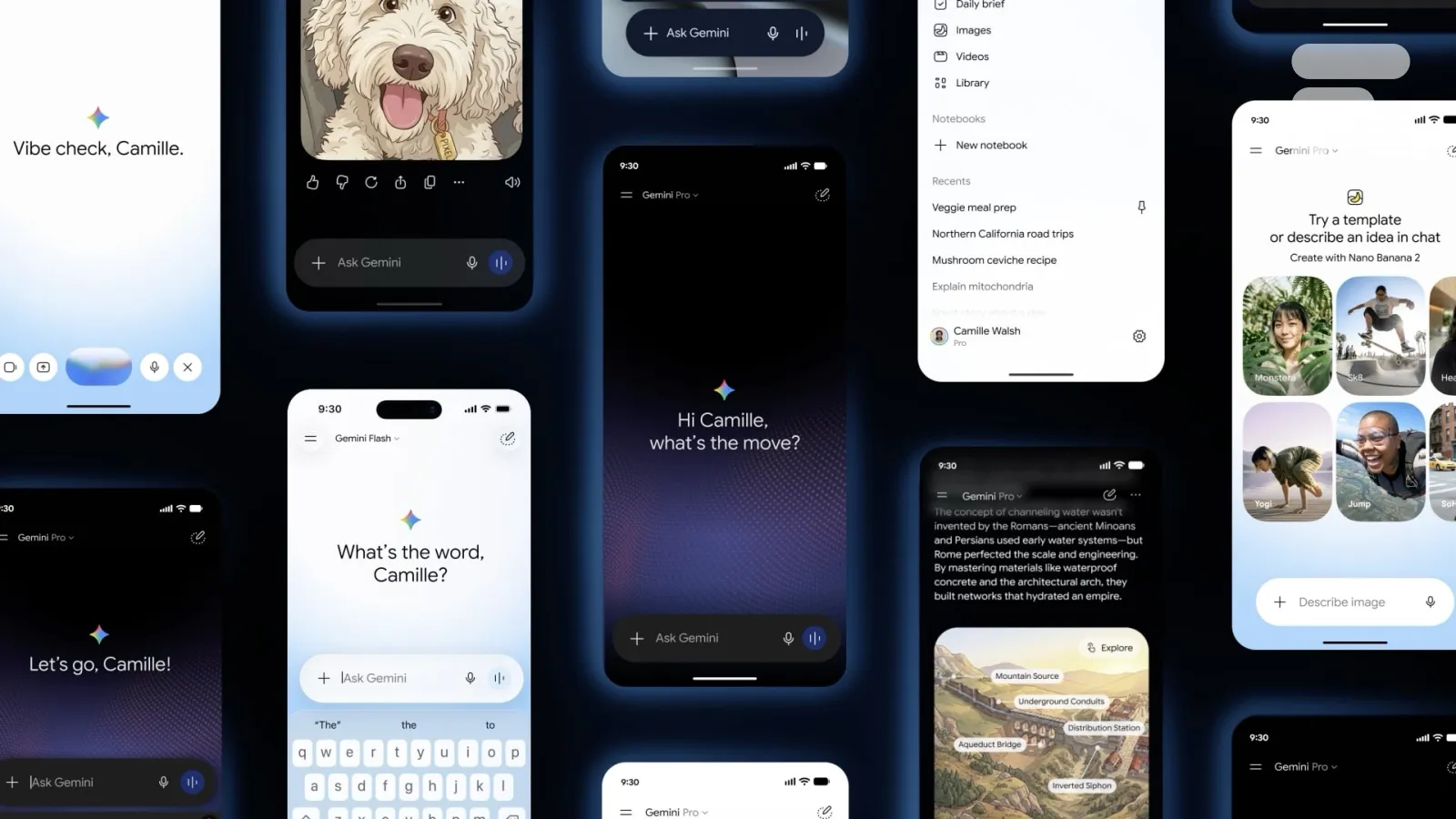
Google has deployed a full redesign of the Gemini app on Android, iOS and web featuring Neural Expressive visuals, structured responses and instant Gemini Live access. The changes support 900 million users and accompany new models plus agent capabilities for paid subscribers.
Tap a lens to see what this story means for you.
Liked this? The Brief brings you the whole day in tech, verified, every morning.
Two minutes, free forever. What's in The Brief →
See what’s happening right now
The Feed runs all day — short, verified briefs the moment they break.
Open the FeedFollow @thecircuitry_
Every story we publish, as it happens. No noise between.
Reader-supported
The Circuitry is a passion project I've always wanted to build, and I love the work behind it.
Running it costs real money. APIs, hosting, time. To keep improving the site and growing this into something useful for everyone, those costs have to be covered.
Any contribution is appreciated. If not, no pressure. Thanks for reading.
NVD published two more high-severity CVE records for IBM Guardium Data Protection 12.2 on September 25: CVE-2026-85542 (CVSS 8.8), a command injection bug, and CVE-2026-85029 (CVSS 7.5), a path traversal flaw. IBM lists fix pack SqlGuard_12.0p233.
Microsoft Office Outlook has an integer overflow flaw, CVE-2026-100208, that could let an unauthorized attacker run code over a network. Microsoft scores it 7.5 (High), and an attack needs user interaction.
CISA added CVE-2026-87902, a WordPress Core remote file inclusion flaw, to its KEV catalog with a September 28 federal deadline. WordPress 7.1.2 fixes it, and the fix is backported to every branch back to 4.7.
CVE-2026-93306, published by NVD on September 25, lets an unauthenticated attacker on the management network crash the ASMI web server in IBM server firmware with a malformed HTTPS request. IBM rates it 7.1 (High) and has released fixed firmware for Power11, Power10 and Power9 systems.
NVD published two high-severity CVE records for IBM Guardium Data Protection 12.2 on September 25. CVE-2026-84884 (CVSS 7.5) covers REST service-account passwords stored in a reversible format, and CVE-2026-84862 (CVSS 7.2) is an insecure deserialization flaw that could allow code execution. IBM points customers to fix pack SqlGuard_12.0p233.