The Circuitry
THE CIRCUITRYYour one-stop source for all tech news
HOMETODAYNEWSFEEDEVENTS
BOOKMARKS
RSS
© 2026 The Circuitry
About UsSourcesContactCorrectionsPrivacy
  • Today
  • Feed
  • Events
  • Saved
Scroll for more
Verification
VERIFIEDConfidence: HIGH
Source identified
Claims cross-referenced
No discrepancies found
Fact-check summary

Reported directly by NVIDIA Blog — the official primary source for this announcement.

Sourcing
1source

via NVIDIA Blog

Markets
NVDA···

Live quote · not investment advice

Home/Tech/NVIDIA Debuts Accelerated Computing Libraries for Research at ISC
VERIFIEDBy Xavier Rivera· ·3 min read

NVIDIA Debuts Accelerated Computing Libraries for Research at ISC

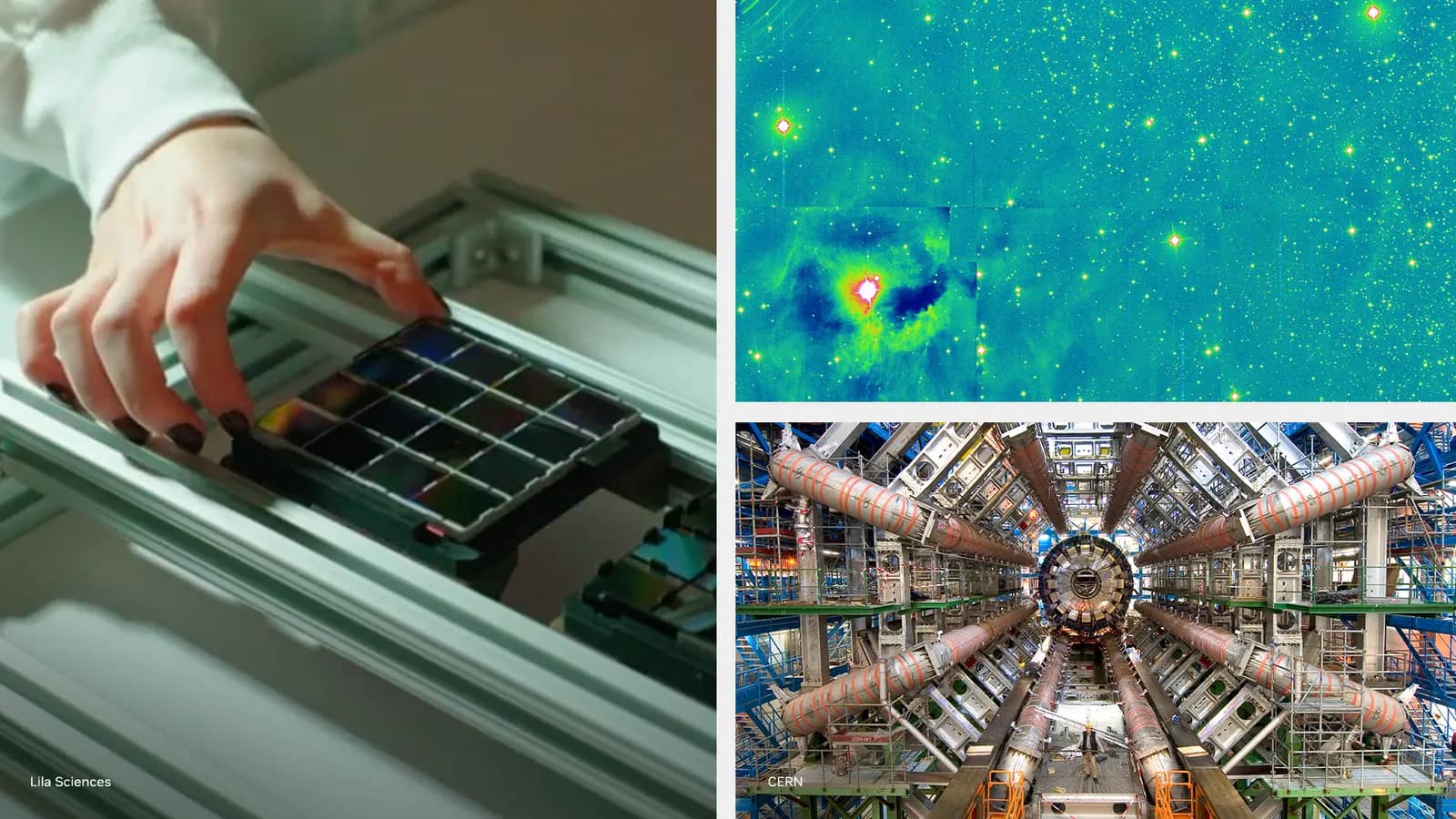
At ISC in Hamburg, NVIDIA unveiled DAQIRI, ALCHEMI NIM microservices and the upcoming cuPhoton reference code to accelerate scientific AI pipelines ranging from chemistry to dark matter searches. The libraries deliver a 14,900x speedup on LSST astronomical data loading and enable real-time analysis of more than 99 percent of CERN collision events that would otherwise be rejected.
Source:NVIDIA Blog
Post
NVIDIA Debuts Accelerated Computing Libraries for Research at ISC
TL;DRAI · 60 sec read

NVIDIA releases DAQIRI, ALCHEMI NIM microservices, and cuPhoton reference code at ISC. These CUDA-X tools accelerate scientific data pipelines from hours or days to real time on GPUs. Researchers in astronomy, chemistry, and particle physics gain faster insights from large datasets, including 14,900x speedups in telescope data and real-time AI at CERN.

At the ISC conference underway in Hamburg this week, NVIDIA rolled out fresh software designed to boost AI performance across scientific fields that include chemistry, materials discovery and the hunt for dark matter.

New tools accelerate data pipelines from hours or days to real time. The NVIDIA DAQIRI library, newly released ALCHEMI NIM microservices and the forthcoming NVIDIA cuPhoton reference code reportedly transform lengthy CPU tasks into GPU-powered real-time workflows. All three belong to NVIDIA CUDA-X, described as a broad set of libraries and tools that deliver dramatically higher performance in AI as well as high-performance computing.

These improvements produce tangible results. Scientists across multiple disciplines now reportedly generate data and extract insights from instruments and large-scale surveys far more quickly than in the past.
New tools accelerate data pipelines from hours or days to real time.

cuPhoton speeds astronomical data processing by orders of magnitude. When deployed on NVIDIA GB200 NVL72 systems, cuPhoton accelerates the loading, reading, processing and analysis of FITS data — the standard file format used by observatories and telescopes. In early access testing it delivered a 14,900x speedup for loading and reading FITS images gathered during the Rubin Observatory’s Legacy Survey of Space and Time (LSST). The code also reportedly achieved up to an 8,400x improvement in signal processing and analysis when run on 32 NVIDIA Grace Blackwell superchips.

Faster pipelines allow quicker insights from the LSST camera, which is described as the largest digital camera ever built and records images of billions of distant galaxies plus faint nearby objects that reflect little light. NVIDIA cuPhoton functions as reference code that helps researchers pull insights from multidimensional data captured by telescopes, X-ray sources and laser experiments. It can load, process, analyze and visualize petabytes of information while combining with additional CUDA-X components to create complete accelerated pipelines for astrophysics and astronomy work.
From The CircuitryThe Feed — live briefs across tech, all day.See what’s happening →
Princeton and Harvard researchers will apply cuPhoton to dark energy surveys. Princeton University scientists worked with NVIDIA to create cuPhoton and plan to deploy it, together with Harvard University colleagues, to handle and examine the enormous datasets produced by observatories and dark energy surveys.

DAQIRI prevents data loss from high-speed instruments. Short for Data Acquisition for Integrated Real-time Instruments, NVIDIA DAQIRI serves as a high-performance networking library that streams information directly from rapid detectors and sensors into NVIDIA software stacks. Legacy hardware often loses data when instruments generate output faster than it can be stored. DAQIRI reportedly keeps pace by managing the incoming stream without delay.
cuPhoton speeds astronomical data processing by orders of magnitude.

Within the CERN openlab framework, the A-GHOST project — created by researchers from CERN, the University of Chicago and University College London — relies on DAQIRI. It performs real-time AI inference on collision data recorded by the ATLAS Experiment at CERN. The system examines more than 99 percent of the data that ATLAS would normally discard because of storage limits, thereby revealing potentially valuable signals that would otherwise go undetected.

ALCHEMI targets chemical and materials discovery. NVIDIA ALCHEMI consists of specialized microservices paired with a toolkit aimed at speeding chemical and materials research. Target applications span battery materials, catalysts, OLED displays, beauty products and additional domains. NVIDIA introduced two ALCHEMI NIM microservices in March for batched geometry relaxation (BGR) and batched molecular dynamics (BMD). The AI-driven utilities let teams simulate millions of molecules and materials in parallel so BGR can identify the most stable configurations while BMD models their motion across time.

ALCHEMI is also slated to add support for the widely adopted Vienna Ab initio Simulation Package (VASP) in the near term, which should raise GPU throughput for materials modeling.
Why this mattersAI · ~100 words

Tap a lens to see what this story means for you.

Reader-supported
DonateBuy me a coffee →Follow@thecircuitry_ →Follow@thecircuitry.to →

Reader-supported · Daily Brief

Daily brief at 7 AM ET. Top tech stories, every morning. Sourced and fact-checked.

HELP US IMPROVE
From The Circuitry

See what’s happening right now

The Feed runs all day — short, verified briefs the moment they break.

Open the Feed →
From The Circuitry

Follow @thecircuitry_

Every story we publish, as it happens. No noise between.

Follow on X ↗On Bluesky ↗

Reader-supported

The Circuitry is a passion project I've always wanted to build, and I love the work behind it.

Running it costs real money. APIs, hosting, time. To keep improving the site and growing this into something useful for everyone, those costs have to be covered.

Any contribution is appreciated. If not, no pressure. Thanks for reading.

Buy me a coffee
NVIDIAAIScientific ComputingCUDA
More inTech
  • OpenAI signs multi-year deal with Getty Images

    Tech · 2h
  • Google discontinues Nest Mini and Nest Audio

    Tech · 22h
  • Tesla files trademark for MEGAPOD AI data center hardware

    Tech · 2d
SupportThe Work

The Circuitry is reader-supported. If you find the daily brief useful, you can buy me a coffee to keep it going.

Buy a coffee →
SubscribeCircuitry Brief

Daily brief at 7 AM ET. Top tech stories, every morning.

MORE IN TECH

OpenAI signs multi-year deal with Getty Images

Getty Images has formed a multi-year partnership supplying licensed visuals to OpenAI search and ChatGPT. The pact comes after the company's past opposition to generative AI, including its 2022 ban on AI art, a lawsuit against Stability AI, and a 2025 content deal with Perplexity AI that mandated image credits.

Google discontinues Nest Mini and Nest Audio

Google has discontinued the Nest Mini and Nest Audio while launching its first new smart speaker in six years, which ships June 25 at $100. The move reflects a shift toward Gemini integration and leaves the product lineup without a direct low-cost option.

Tesla files trademark for MEGAPOD AI data center hardware

Tesla filed a USPTO trademark for MEGAPOD on June 18, 2026, covering modular data center hardware for AI computing. The live pending application signals the company's continued focus on AI infrastructure products.