The Circuitry
THE CIRCUITRYYour one-stop source for all tech news
HOMETODAYNEWSFEEDEVENTS
BOOKMARKS
RSS
© 2026 The Circuitry
About UsSourcesContactCorrectionsPrivacy
  • Today
  • Feed
  • Events
  • Saved
Scroll for more
Verification
VERIFIEDConfidence: HIGH
Source identified
Claims cross-referenced
No discrepancies found
Sourcing
1source

via Teslarati

Teslarati · track record
14Stories
100%Verified
030d
All sources →
Home/Energy/SpaceX Targets May 20 Launch for Starship V3 Debut
VERIFIEDBy Xavier Rivera· ·2 min read

SpaceX Targets May 20 Launch for Starship V3 Debut

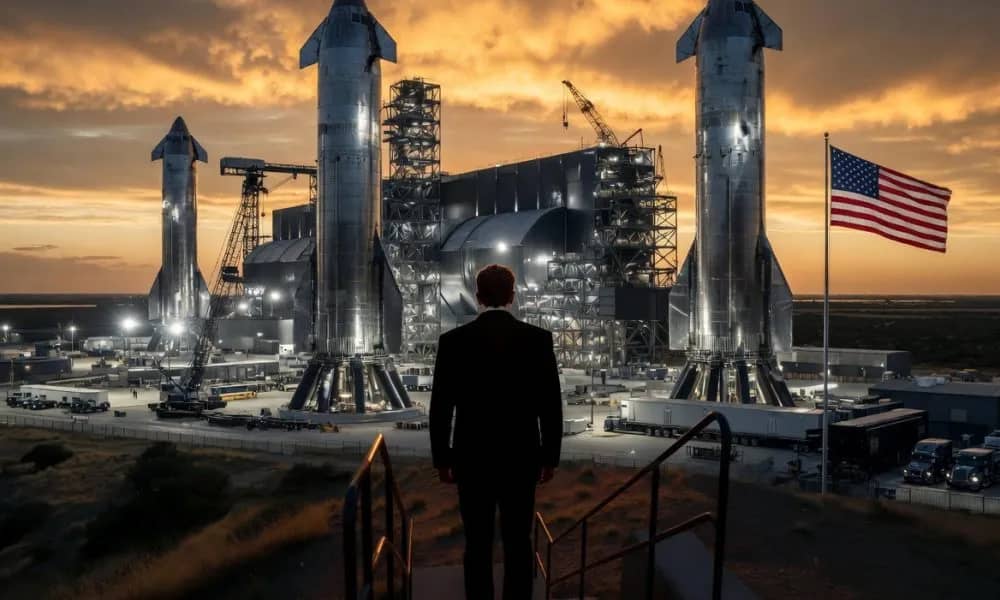
SpaceX is targeting May 20 for the debut launch of Starship V3 from its new Pad 2 at Starbase. The upgraded vehicle triples payload capacity to more than 100 metric tons, enables scaled in-orbit refueling for NASA Artemis lunar missions, and advances Musk's Mars settlement plans tied to a potential $7.5 trillion valuation.
Source:Teslarati
Post
SpaceX Targets May 20 Launch for Starship V3 Debut
TL;DRAI · 60 sec read

SpaceX targets May 20 for the debut of Starship V3 on Flight 12 from its new launch pad in South Texas following full static fire tests of the vehicle. V3 handles over 100 metric tons to orbit and makes possible the repeated tanker flights needed to support NASA lunar landings by 2028 and eventual Mars settlement.

SpaceX plans to send its most advanced Starship iteration aloft on Flight 12, scheduled for Wednesday, May 20, at 6:30 p.m. ET from the newly constructed Pad 2 at Starbase in South Texas. The mission introduces both the V3 vehicle and the fresh launch infrastructure in one outing.

Hardware gains include the ability to deliver more than 100 metric tons to orbit while remaining reusable, approximately three times the capacity of earlier models. Engineers made the rocket lighter and less complex, steps that reportedly lower the chance of part failures and cut overall operating expenses. The dual-pad setup now lets technicians ready two vehicles simultaneously.

Programmatic stakes center on turning prototypes into operational hardware. NASA requires a dependable Starship to serve as the Human Landing System for its Artemis program, where a crewed lunar touchdown is targeted for 2028 under Artemis IV. Achieving that goal first demands repeated in-orbit propellant transfers, a feat that will need more than ten tanker flights to load one lunar mission. V3 was engineered to make those operations affordable.
POST FROM @SpaceX· official SpaceX tweet on V3 launch rehearsal and propellant loading ahead of the targeted debut flight
https://x.com/SpaceX/status/2053929135936864393

Elon Musk has said the upgraded Starship should support early flights to Mars. "Every previous Starship was essentially a prototype," while the new design "is the version SpaceX actually intends to put to work," according to the company. The vehicle is meant to transport people and supplies at volumes that could sustain a permanent settlement.
From The CircuitryThe Feed — live briefs across tech, all day.See what’s happening →

On May 7, SpaceX finished the first complete-duration, full-thrust static fire of the 33-engine V3 Super Heavy booster after two abbreviated firings caused by ground-system problems. The Ship upper stage had passed its own static-fire test in April. Together the results clear both V3 stages for their joint debut on Flight 12.

Successful runs strengthen broader ambitions. Musk's compensation package from January 2026 grants him 200 million shares once SpaceX attains a $7.5 trillion valuation and contributes to a one-million-person Mars colony. The company aims for a Nasdaq IPO as soon as June 12 at a $1.75 trillion valuation while managing more than $22 billion in active government contracts across defense, NASA, and broadband sectors.
SpaceX also maintains roughly 10,000 Starlink satellites on orbit, giving it extensive real-world data on managing large constellations safely.
Why this mattersAI · ~100 words

Tap a lens to see what this story means for you.

Reader-supported
DonateBuy me a coffee →Follow@thecircuitry_ →Follow@thecircuitry.to →

Reader-supported · Daily Brief

Daily brief at 7 AM ET. Top tech stories, every morning. Sourced and fact-checked.

HELP US IMPROVE
From The Circuitry

See what’s happening right now

The Feed runs all day — short, verified briefs the moment they break.

Open the Feed →
From The Circuitry

Follow @thecircuitry_

Every story we publish, as it happens. No noise between.

Follow on X ↗On Bluesky ↗

Reader-supported

The Circuitry is a passion project I've always wanted to build, and I love the work behind it.

Running it costs real money. APIs, hosting, time. To keep improving the site and growing this into something useful for everyone, those costs have to be covered.

Any contribution is appreciated. If not, no pressure. Thanks for reading.

Buy me a coffee
SpaceXStarshipStarshipV3
More fromTeslarati
  • Tesla Expands Unsupervised Robotaxi to Full Austin Metro

    Tech · 1mo
  • Tesla Authorized for Commercial Driverless Operations in Texas

    Tech · 1mo
  • NASA Adds Six More Missions to SpaceX Crew Contract

    Tech · 1mo
More inEnergy
  • Energy Dept. Orders Data Centers to Use Backup Power

    Energy · 2d
  • China Plans 400 km Solar Wall to Fight Desertification

    Energy · 9d
  • Walmart signs first nuclear power purchase agreement

    Energy · 9d
SupportThe Work

The Circuitry is reader-supported. If you find the daily brief useful, you can buy me a coffee to keep it going.

Buy a coffee →
SubscribeCircuitry Brief

Daily brief at 7 AM ET. Top tech stories, every morning.

MORE IN ENERGY

Energy Dept. Orders Data Centers to Use Backup Power

The Department of Energy has authorized PJM to require data centers to use backup power during a heat wave straining the grid this week. The move highlights growing electricity demand from AI-driven data centers in a region with the world's largest concentration of such facilities.

China Plans 400 km Solar Wall to Fight Desertification

China is building a 400 km solar corridor along the Kubuqi Desert that will reach 100 GW by 2030 while helping halt desert expansion. The dual-purpose project already has sections operating and could generate nearly 40 TWh of electricity annually.

Walmart signs first nuclear power purchase agreement

Walmart signed its first nuclear power purchase agreement with Constellation Energy on June 23, securing about 176 MW of zero-emission electricity from the Dresden Clean Energy Center in Illinois via two 15-year contracts that begin in 2029 and 2030. The deal includes 30 MW of new generation capacity and represents the retailer's initial step into nuclear energy procurement for clean power supply.