A hydraulic pin on the Starbase launch tower umbilical failed to retract, scrubbing SpaceX’s first Starship V3 attempt 40 seconds before liftoff on Thursday. The redesigned vehicle is central to NASA’s lunar ambitions ahead of China, expanded Starlink and orbital data center plans, and precedes the company’s anticipated IPO.
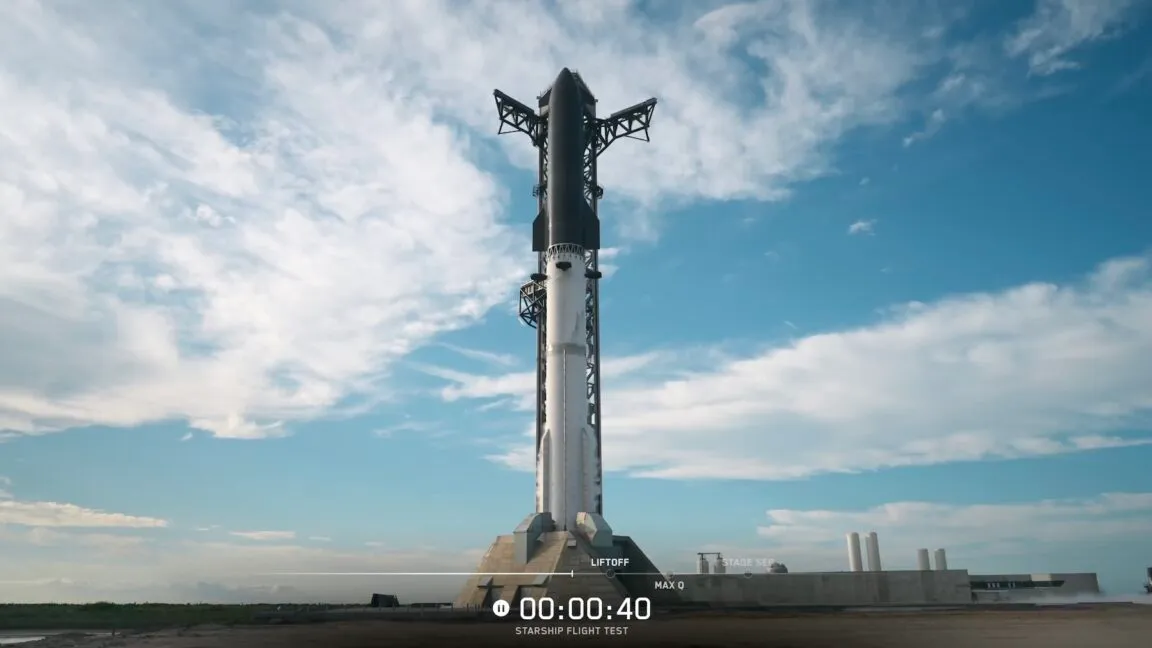
A technical snag with the launch tower halted SpaceX's initial attempt to send up its taller and more powerful Starship Version 3 rocket on Thursday, stopping the countdown with less than a minute remaining.
After weather improved at the South Texas site, with skies clearing to mostly sunny conditions by afternoon, the company delayed the scheduled liftoff by one hour. Propellant loading went without apparent trouble, but the automated sequence froze at T-minus 40 seconds. Controllers tried multiple times to restart the clock, yet the system triggered five separate holds before managers scrubbed the effort.
“It is sounding like we are not going to be able to clear this issue in time today, so we are going to be standing down from a launch,” said Dan Huot, a SpaceX official hosting the company’s live broadcast Thursday. “We got the vehicle totally loaded. We hit a couple of different holds as we worked through that count.”
SpaceX founder Elon Musk reported that the problem involved a hydraulic pin on an umbilical arm that connects the tower to the vehicle and failed to retract. “If that can be fixed tonight, there will be another launch attempt tomorrow,” Musk wrote on X. A 90-minute window for Friday opens at 5:30 p.m. CDT (22:30 UTC).
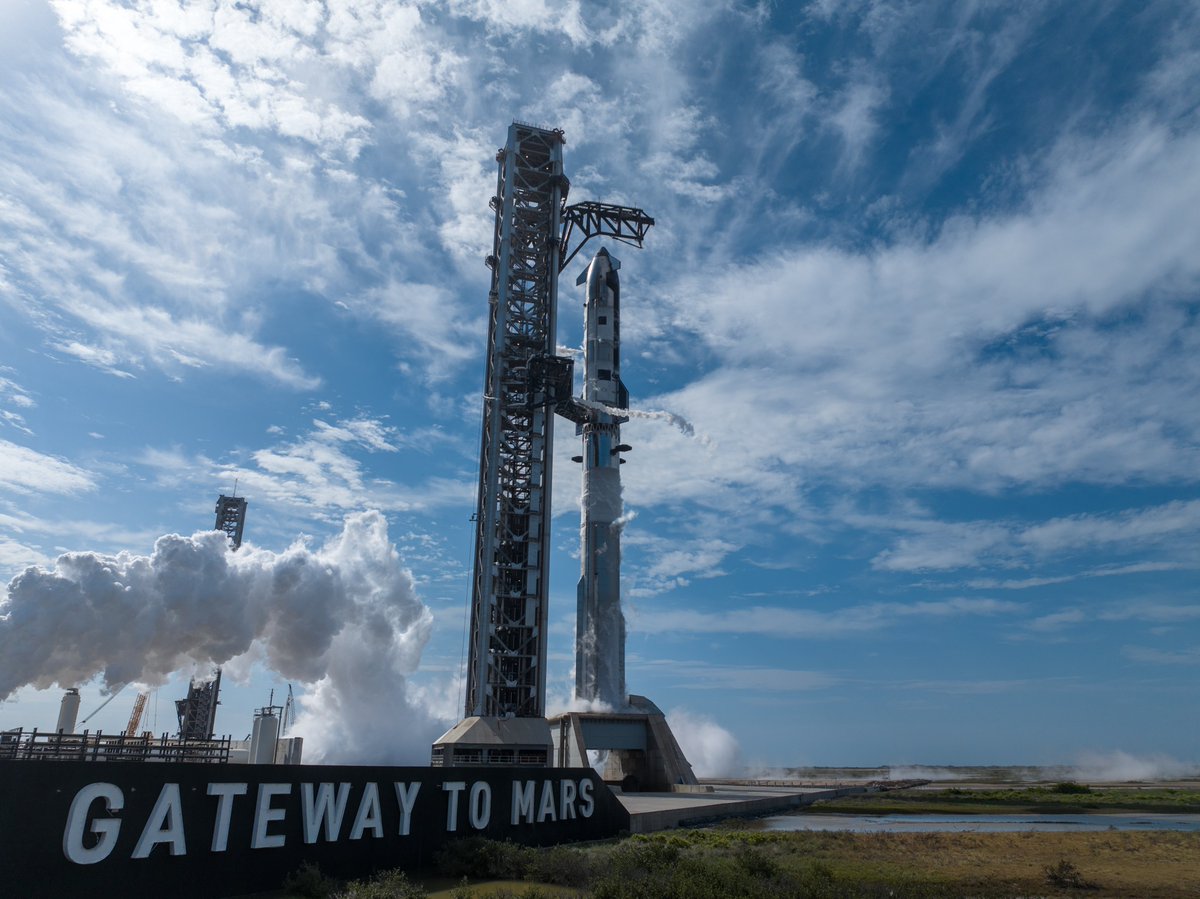
The test represents the first departure from an entirely new pad at Starbase, Texas, the roughly one-year-old municipality built around SpaceX’s facility near the U.S.-Mexico border. It counts as the 12th integrated flight of the full Starship stack and marks the debut of an extensively revised configuration the company designates Starship Version 3. Among the updates are 39 Raptor engines offering greater efficiency and thrust, an overhauled propulsion architecture, three enlarged grid fins in place of four smaller units, and a hot staging ring that remains fixed to the top of the Super Heavy booster for reuse.
Considerable stakes surround the flight. It supports NASA’s reported goal of achieving a crewed lunar landing ahead of China, underpins SpaceX’s schedule for rolling out upgraded Starlink satellites plus orbital data centers, and advances the wider industry’s pursuit of affordable space access. The attempt also arrives shortly before the firm’s expected initial public offering. Although the vehicle pair is engineered for complete reusability, only the booster has flown again so far, and neither stage will be caught after this mission.
During Thursday’s countdown the team largely duplicated steps from a recent full rehearsal. More than 11 million pounds of liquid oxygen and methane were loaded in under 40 minutes, a quicker pace than earlier Starship variants required. By comparison, filling roughly one million pounds of propellant into a Falcon 9 takes SpaceX about the same interval.
Once airborne, the trajectory stays broadly consistent with prior tests but includes modest adjustments. The stack will fly a bit farther south across the Gulf of Mexico, threading between Cuba’s western end and Mexico’s Yucatan Peninsula instead of crossing near the Florida Keys. Separation of the more than 20-story-tall Super Heavy booster is planned for nearly two-and-a-half minutes after liftoff, after which it will steer toward a targeted splashdown off the Texas coast. The upper stage’s six engines should accelerate the vehicle halfway around Earth—short of orbital velocity—before releasing 20 dummy next-generation Starlink satellites along with two camera-equipped units to image the ship in flight. Starship V3 uses a revised dispenser that ejects the satellites more rapidly than the Version 2 design, a step SpaceX says will speed operational deployments possibly later this year.
Roughly 48 minutes after launch, the vehicle is expected to re-enter over the Indian Ocean. Teams will monitor heat shield behavior before a final engine burn aims for a precise splashdown northwest of Australia.
SpaceX has stated that “the flight test’s primary goal will be to demonstrate each of these new pieces in the flight environment for the first time, with each element of the Starship architecture featuring significant redesigns to enable full and rapid reuse that incorporate learnings from years of development and test.” The company maintains a substantial inventory of Version 3 hardware, suggesting any early mishap would not impose a long delay. Musk noted the seven-month interval since the previous launch stemmed from “the almost total redesign of the primary structure, engines, electronics and launch tower from V2.”

https://x.com/SpaceX/status/2056854244951515507
Tap a lens to see what this story means for you.
Liked this? The Brief brings you the whole day in tech, verified, every morning.
Two minutes, free forever. What's in The Brief →
See what’s happening right now
The Feed runs all day — short, verified briefs the moment they break.
Open the FeedFollow @thecircuitry_
Every story we publish, as it happens. No noise between.
Reader-supported
The Circuitry is a passion project I've always wanted to build, and I love the work behind it.
Running it costs real money. APIs, hosting, time. To keep improving the site and growing this into something useful for everyone, those costs have to be covered.
Any contribution is appreciated. If not, no pressure. Thanks for reading.
SpaceX has delayed the first orbital Starship flight from September 22 to September 28 pending regulatory approval. The mission will attempt to place 26 V3 Starlink satellites into a 275 km orbit and marks a key milestone after the program's initial test flight in 2023.
SpaceX completed a static fire of Booster 20 on July 10, clearing the path for Starship's 13th test flight as early as July 15. The test continues development of the Version 3 vehicle toward full operational capability including stage recovery and reuse.
SpaceX Starship reached orbit for the first time on its 14th test flight from Texas on September 28 despite an early engine shutdown. The vehicle is expected to complete six orbits over 10 hours and deploy 26 Starlink V3 satellites before Pacific splashdown.
NASA and SpaceX are targeting a 7:26 AM EDT Sunday liftoff of a Falcon Heavy from Kennedy Space Center carrying the Nancy Grace Roman Space Telescope. The observatory will travel to Sun-Earth L2, where its Wide Field and Coronagraph instruments will search for exoplanets and study dark energy.
SpaceX plans to attempt catching its Starship spacecraft with mechanical tower arms on the next test flight following a successful ocean landing on Flight 13. The milestone would advance the vehicle's reusability after demonstrating satellite deployment and an in-flight engine restart.