Microsoft Edge is adopting a two-week release cycle for its Stable channel beginning with version 152 on August 27, while Extended Stable remains on an eight-week schedule. The shift delivers smaller, more frequent updates and faster security improvements to help organizations validate changes more easily.
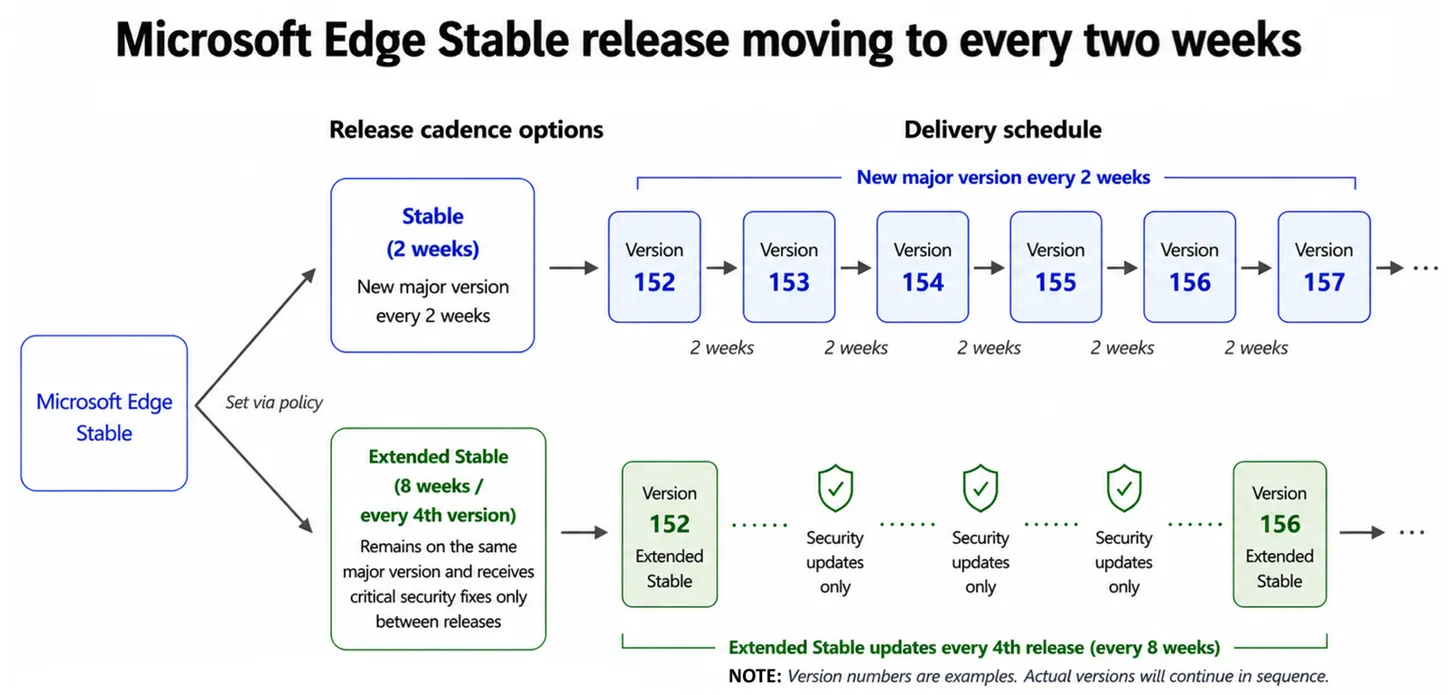
Each release brings about half as much new content as before while delivering it twice as often.
The pace of Edge is accelerating with more features and improvements arriving sooner and more often.
Enterprises should immediately incorporate Beta channel pilots via Enterprise Preview to gain maximum validation time under the accelerated cadence.
Tap a lens to see what this story means for you.
Liked this? The Brief brings you the whole day in tech, verified, every morning.
Two minutes, free forever. What's in The Brief →
See what’s happening right now
The Feed runs all day — short, verified briefs the moment they break.
Open the FeedFollow @thecircuitry_
Every story we publish, as it happens. No noise between.
Reader-supported
The Circuitry is a passion project I've always wanted to build, and I love the work behind it.
Running it costs real money. APIs, hosting, time. To keep improving the site and growing this into something useful for everyone, those costs have to be covered.
Any contribution is appreciated. If not, no pressure. Thanks for reading.
OpenAI released GPT-6.1 Terra, a mid-tier model in its GPT-6 line that it says delivers faster, cheaper computer use than GPT-5.6 Terra. API pricing is $1 per million input tokens and $5 per million output tokens, half of GPT-6.1 Sol's rates. It is live in ChatGPT Work and Codex for Plus, Pro, Enterprise and Edu users and in the API as gpt-6.1-terra; the benchmark results are OpenAI's own.
The Golden Joystick Awards revealed 12 Ultimate Game of the Year nominees, including 007 First Light, Big Walk, Resident Evil Requiem, Crimson Desert and Forza Horizon 6. Fan voting runs until 11:59 PM GMT on Friday, Oct. 30, with winners announced at the Nov. 11 ceremony at Troxy in London, hosted by Alix Wilton Regan. GTA 6 is absent because it launches Nov. 19, after voting and the show.
Auroch Digital, the Bristol studio behind Boltgun 2, said it has begun a redundancy consultation affecting around a quarter of roles as it restructures. It is owned by Roundtable Interactive. Support for Boltgun 2 and Warhammer Survivors (launching Nov 10) will continue. It gave no headcount.
Phantom Blade Zero's PC pre-load opens October 26 at 7:00 PM PDT (10 PM AST), per the game's official X account, which says the game is about 145 GB and asks players to reserve at least 300 GB of free SSD space for the pre-load. The game unlocks October 28 at 7:00 PM PDT (October 29, 10 AM Beijing) for everyone at once, on PS5 and PC.
Microsoft on Monday announced a new Voluntary Exit Offer for eligible employees in participating teams in the US, Canada, India and the UK at level 70 and below. Chief People Officer Amy Coleman's memo says it "builds on what we learned" from April's Voluntary Retirement Program. About 60,000 people, roughly a quarter of its 223,000 staff, are eligible, the company told GeekWire. A person familiar told CNBC that employees decide in December and leave Dec. 31. Some groups, including sales, aren't participating, and Microsoft says the offer doesn't replace layoffs.